Starbucks faces six separate lawsuits right now. Each one covers different ground: coffee chemicals, ethical sourcing claims, hot coffee burns, union rights, and investor losses. None of these cases are related to each other, and no single case represents “the” Starbucks lawsuit. This guide breaks down what each case alleges, where it stands, and what it means depending on who you are: a customer, a shareholder, or a former employee.
Starbucks Lawsuits
| Case | Type | Filed | Court | Status |
|---|---|---|---|---|
| Williams v. Starbucks Corp. | Consumer class action (coffee chemicals, sourcing claims) | January 13, 2026 | U.S. District Court, Western District of Washington | Active; amended complaint filed April 23, 2026 |
| National Consumers League v. Starbucks | Consumer suit (child labor and trafficking claims) | January 2024 | District of Columbia court | Ongoing |
| Actis Law Group class action | Canadian consumer class action | 2026 | Quebec (proposed) | Active, class not yet certified |
| Walker v. Starbucks | Personal injury (hot coffee burn) | 2026 | Riverside County, California | Filed |
| Evans v. Starbucks | Personal injury (hot coffee burn) | 2022 | Los Angeles County Superior Court | Filed, litigation ongoing |
| NLRB rulings and charges | Federal labor law disputes | Ongoing since late 2021 | National Labor Relations Board and federal courts | Pattern of mixed rulings, still active |
| Garbaccio v. Starbucks Corp. | Securities class action | 2024 | U.S. District Court, Western District of Washington | Lead plaintiff deadline passed; case proceeding |
Each case gets a full breakdown below. A quick note on scope: this article does not cover routine slip-and-fall claims or one-off local disputes that never reached a courtroom. It covers cases with actual filings, a named court, and public documentation.
The Coffee Chemicals and Ethical Sourcing Lawsuit (Williams v. Starbucks)
This is the case most people mean when they search for a Starbucks lawsuit right now.
Two consumers, Jennifer Williams of Ferndale, Washington, and David Strauss of Irvington, New York, filed a class-action complaint against Starbucks on January 13, 2026. The case sits in the U.S. District Court for the Western District of Washington, assigned to Judge Michelle L. Peterson under case number 2:26-cv-00112. A first amended complaint followed on April 23, 2026. The firm representing the plaintiffs, Hagens Berman Sobol Shapiro, has a long track record in consumer class actions, including prior cases against Amazon and Colgate over contamination claims.
What the lawsuit alleges
The complaint raises two separate accusations, and readers often conflate them. They are not the same claim.
Claim one: misleading ethical sourcing statements. Starbucks packaging states the company is “Committed to 100% Ethical Coffee Sourcing” through its Coffee and Farmer Equity Practices program, known as C.A.F.E. Practices. The lawsuit cites investigations by journalists, labor organizations, and human-rights monitors documenting labor abuses at farms that held C.A.F.E. certification anyway. Those alleged abuses include unsafe working conditions without protective gear, substandard worker housing, and violations of local labor law. The complaint states that Starbucks kept sourcing from these farms even after repeated notice of the violations.
Claim two: undisclosed chemicals in decaf coffee. Independent testing commissioned by the plaintiffs’ legal team found three volatile organic compounds in Starbucks’ decaf house blend medium roast: methylene chloride at 22 parts per billion, benzene at 28 parts per billion, and toluene at 87 parts per billion. The lawsuit argues these levels exceed EPA safety thresholds and are inconsistent with a “100% Arabica coffee” label, since none of these compounds occur naturally in coffee. Toluene in particular is not authorized as a food ingredient under federal rules, according to the complaint.
What the science says
Two of the three chemicals named in the suit carry documented cancer risk under separate federal and international assessments, independent of this lawsuit’s own claims. The EPA has found that methylene chloride poses an unreasonable health risk, including cancer risk, at meaningful exposure levels. The International Agency for Research on Cancer, part of the World Health Organization, classifies benzene as a known human carcinogen. Toluene carries a different risk profile: it is not classified as a carcinogen, but chronic exposure is linked to neurotoxic effects such as dizziness and headaches.
A separate and important fact belongs here, because confusing it with the chemical claims would be inaccurate. The EPA has found that methylene chloride poses an unreasonable health risk, including cancer risk, at meaningful exposure levels. That 2016 finding covers coffee as a beverage. It does not address the specific VOC contamination alleged in this 2026 lawsuit, and the two claims should not be merged into one conclusion.
Starbucks’ response
A Starbucks representative addressed the allegations directly: the company takes the claims in the case seriously but believes they misrepresent both its sourcing practices and the C.A.F.E. Practices program. Starbucks maintains it audits farms regularly and ends supplier relationships when violations surface. On the chemical claims, the company states its coffee meets or exceeds applicable safety standards. None of these statements have been tested in court yet.
Case history: this is not Starbucks’ first coffee-chemical suit
A similar dispute played out in California in 2018. The Council for Education and Research on Toxics sued roughly 90 coffee retailers, Starbucks among them, over failure to warn about acrylamide, a byproduct of roasting linked to cancer in lab animal studies. A judge initially required a warning label. A California Superior Court judge dismissed the case in 2020 after further review. That earlier case involved a different chemical, a different legal theory (California’s Prop 65 warning requirement), and a different outcome. It is useful background, not a predictor of how the 2026 case resolves.
National Consumers League v. Starbucks
The National Consumers League filed a separate consumer-protection lawsuit against Starbucks in a Washington, D.C. court. This case predates the Williams litigation and focuses on a different set of claims: that Starbucks sources coffee and tea from farms tied to documented human rights abuses, including child labor and human trafficking, while marketing the products as “100% ethical.” The organization’s executive director, Sally Greenberg, argued publicly that the company charges a price premium for a sourcing claim it cannot support.
Starbucks confirmed awareness of the suit and stated it plans to defend against the claims. The company pointed to its human rights statement and its supply chain reverification process as evidence of compliance.
This case and the Williams case share a theme (ethical sourcing claims) but were filed separately, by separate plaintiffs, in separate courts, under separate legal theories. They should not be treated as the same lawsuit.
The Canadian Class Action (Actis Law Group)
A Canadian version of the sourcing and chemicals dispute is active as well. Actis Law Group, a Montreal-based class-action firm, filed a proposed class action on behalf of Canadian consumers who purchased Starbucks coffee products. The claims mirror the U.S. Williams case closely: misleading “100% Ethical Coffee Sourcing” language, misleading “100% Arabica” claims, and the same VOC findings in decaf coffee.
Canadian class actions differ from U.S. proceedings in one key way worth flagging for readers: the class has not been certified by a court yet, which is a required step under Canadian civil procedure before the case can proceed on behalf of a group. Participation costs consumers nothing regardless of certification status, since the firm operates on contingency.
Hot Coffee Burn Lawsuits (Walker v. Starbucks and Evans v. Starbucks)
Two separate personal injury cases allege the same failure: a coffee lid that did not hold, paired with a beverage temperature the plaintiffs say was unreasonably high.
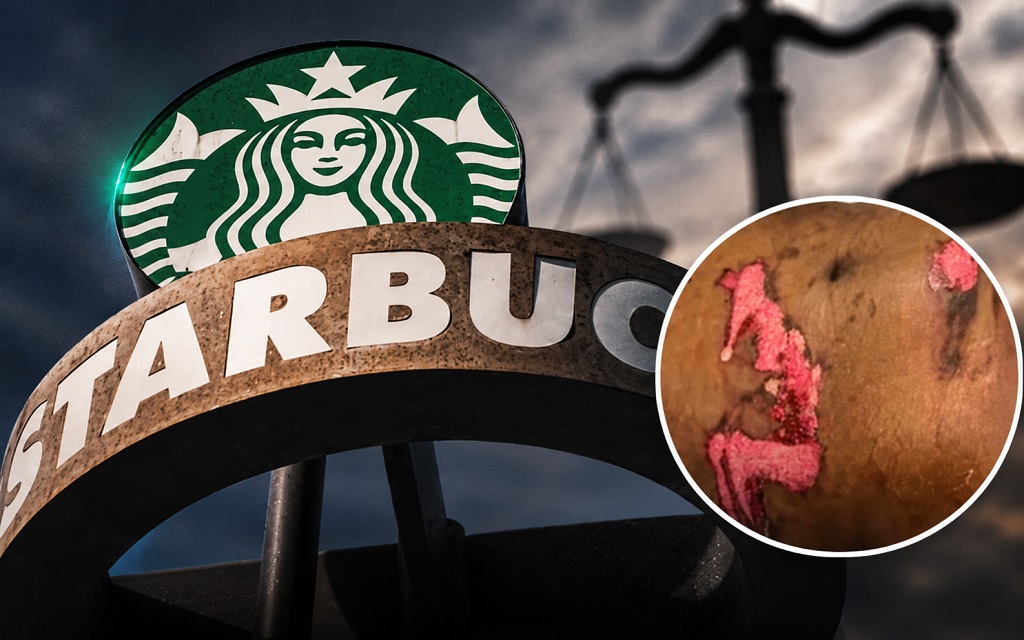
Walker v. Starbucks. Leota Walker visited a Starbucks drive-through in Wildomar, in Riverside County, California, in 2026. Her attorneys say a lid popped off her cup and spilled near-boiling liquid onto her stomach, inner thighs, and groin. She suffered second-degree burns and underwent surgery after several weeks of hospital treatment. Her attorney, Daniel DeSantis, argues the company has known about lid-related complaints for years and continues to serve coffee at an unsafe temperature despite the pattern. Starbucks declined to comment on the pending case.
Evans v. Starbucks. A separate incident involved Muriel Evans, who filed a complaint in Los Angeles County Superior Court in Compton after an August 2022 drive-through visit in Lynwood. Her complaint alleges a barista mishandled her order and spilled coffee into her lap, causing severe burns, nerve damage, and disfigurement. Evans seeks compensatory and punitive damages. Starbucks stated it takes all safety claims seriously but declined to comment on pending litigation.
The pattern behind these cases
Neither Walker nor Evans is the first burn claim against Starbucks, and their attorneys reference this pattern directly. A Los Angeles County jury previously awarded a plaintiff $50 million in a comparable case against the company. That verdict is not binding on either current case, but plaintiffs’ attorneys in both new suits cite it as evidence the company has known about the risk and chosen not to change its lid design or serving temperature.
Labor Law Disputes: The NLRB Pattern
Starbucks faces a different kind of legal exposure entirely: an ongoing, years-long pattern of unfair labor practice charges tied to its employees’ unionization effort, which began in Buffalo, New York, in late 2021. Over 1,100 unfair labor practice charges have been filed against the company with the National Labor Relations Board since the campaign started. Starbucks Workers United now represents workers at more than 350 stores.
No single lawsuit captures this dispute. It is better understood as a running scoreboard, and recent months show wins on both sides.
Recent rulings against Starbucks
On June 5, 2026, the NLRB issued two separate rulings against the company covering Seattle and Portland stores. The Seattle ruling found managers unlawfully questioned striking employees about their shift plans without explaining why or promising no retaliation. The Portland ruling found the company unlawfully disciplined union supporters.
Recent rulings favoring Starbucks
On August 5, 2026, the Republican-controlled NLRB ruled in Starbucks’ favor on a separate claim that it improperly blocked unionized employees from picking up shifts at non-union stores. In March 2026, an NLRB administrative law judge dismissed a separate set of claims alleging the company’s dress code policy was enforced in a discriminatory, anti-union manner, finding no evidence of selective enforcement.
The Supreme Court precedent
In June 2024, the Supreme Court ruled 8-1 in Starbucks Corp. v. McKinney that the NLRB must meet a stricter four-factor legal test before a federal court can grant the agency’s request for an injunction. That decision raised the bar for one of the NLRB’s key enforcement tools and now shapes how every subsequent case in this pattern gets litigated.
The practical read here: this is not a case you can “check the status” of, because it is not one case. New charges, hearings, and rulings continue on a rolling basis, and the current NLRB’s political composition has shifted some recent outcomes in Starbucks’ favor compared to earlier years in the dispute.
The Securities Class Action (Garbaccio v. Starbucks Corp.)
Shareholders filed a separate securities class action, Garbaccio v. Starbucks Corporation, in the Western District of Washington under case number 24-cv-01362. The claims center on statements Starbucks made between November 2, 2023, and April 30, 2024, the defined class period. Plaintiffs allege the company overstated confidence in its growth outlook, particularly in China, and that its “Reinvention” turnaround platform failed to meet its own stated benchmarks. The stock dropped after the company’s April 30, 2024, earnings report showed a 4% global decline in same-store sales and a 7% drop in customer traffic.
The lead plaintiff application deadline was October 28, 2024, and has passed. The case continues through the standard securities litigation process. This case matters only to people who held Starbucks stock during the defined class period; it has no bearing on customers or employees.
What This Means Depending on Who You Are
- If you are a Starbucks customer: No court has ruled on the VOC or sourcing claims yet, and Starbucks disputes them. If a class gets certified and a settlement follows, notice typically goes out automatically to anyone who bought the relevant products during the covered period; you generally do not need to take action now to preserve a future claim. Watch official case pages or court dockets, not secondhand social posts, for real certification news.
- If you were burned by hot coffee at a Starbucks location: These are individual personal injury claims, not class actions, and each case turns on its own facts. A prior $50 million verdict shows juries take these claims seriously, but it does not guarantee any specific outcome. Speak with a personal injury attorney promptly, since burn injury claims carry statutes of limitations that vary by state.
- If you are a current or former Starbucks employee involved in union activity: The NLRB process runs independently of these consumer and injury cases. However, if you believe you experienced retaliation, you can file a charge directly with the NLRB; charges do not require an attorney to initiate, though many workers involved in this multi-year dispute have union or legal representation.
- If you held Starbucks stock between November 2023 and April 2024: The lead plaintiff deadline has passed, but absent class members are typically still covered by any future settlement or judgment without having filed anything themselves. Confirm your status through official case counsel if you want specifics tied to your holdings.
FAQs
Is Starbucks being sued right now?
Yes. Starbucks faces six active legal disputes as of August 2026: a consumer class action over coffee chemicals and sourcing claims, a related Washington, D.C., suit from the National Consumers League, a Canadian class action, two personal injury lawsuits over hot coffee burns, an ongoing pattern of NLRB labor rulings, and a securities class action from shareholders.
What chemicals were found in Starbucks decaf coffee?
Independent testing commissioned by plaintiffs’ counsel in the Williams v. Starbucks case found methylene chloride, benzene, and toluene in Starbucks’ decaf house blend medium roast. The lawsuit states these levels exceed EPA safety thresholds. Starbucks disputes the claim and says its coffee meets applicable safety standards.
Does coffee cause cancer?
General coffee consumption is not classified as a cancer risk. The IARC reviewed more than 1,000 studies in 2016 and found no strong evidence linking regular coffee drinking to cancer. That finding is separate from the specific 2026 lawsuit over VOC contamination in one product line, which has not been decided by a court.
Has Starbucks lost the coffee chemicals lawsuit?
No. As of August 2026, the Williams v. Starbucks case remains active with an amended complaint filed in April 2026. No trial date, settlement, or ruling on the merits has occurred.
Can I join the Starbucks class action lawsuit?
If a class gets certified in either the U.S. or Canadian case, eligible consumers typically receive automatic notice through a court-appointed administrator. You generally do not need to sign up in advance to preserve your right to a future claim, though monitoring the official case page helps you stay informed.
Why does Starbucks keep facing labor lawsuits?
Starbucks Workers United has organized more than 350 stores since the campaign began in Buffalo in late 2021, and over 1,100 unfair labor practice charges have followed. Rulings have gone both directions in 2026: some findings against Starbucks over interrogation and discipline, and some findings for the company on scheduling and dress code claims.
Is the Starbucks hot-coffee lawsuit related to the coffee-chemicals lawsuit?
No. The burn lawsuits (Walker and Evans) are personal injury claims about beverage temperature and lid failure. The chemicals lawsuit (Williams) is a consumer-protection claim concerning undisclosed substances and sourcing statements. They involve different plaintiffs, different legal theories, and different courts.
Disclaimer: This article separates confirmed filings from allegations throughout. Case numbers, filing dates, and court assignments come from public court records and law firm case pages. Chemical exposure risk claims (EPA and IARC classifications) come from those agencies’ own published assessments, independent of the lawsuit’s own allegations. Starbucks’ public statements are quoted from company representatives as reported to news outlets covering each case; none of the allegations in any active case have been proven or admitted at this stage. This page will be updated as cases move through the courts.

Musarat Bano is a content writer for JudicialOcean.com who covers lawsuits, legal news, and general legal topics. Her work focuses on research-based, informational content developed from publicly available sources and is intended to support public awareness. She does not provide legal advice or professional legal services.