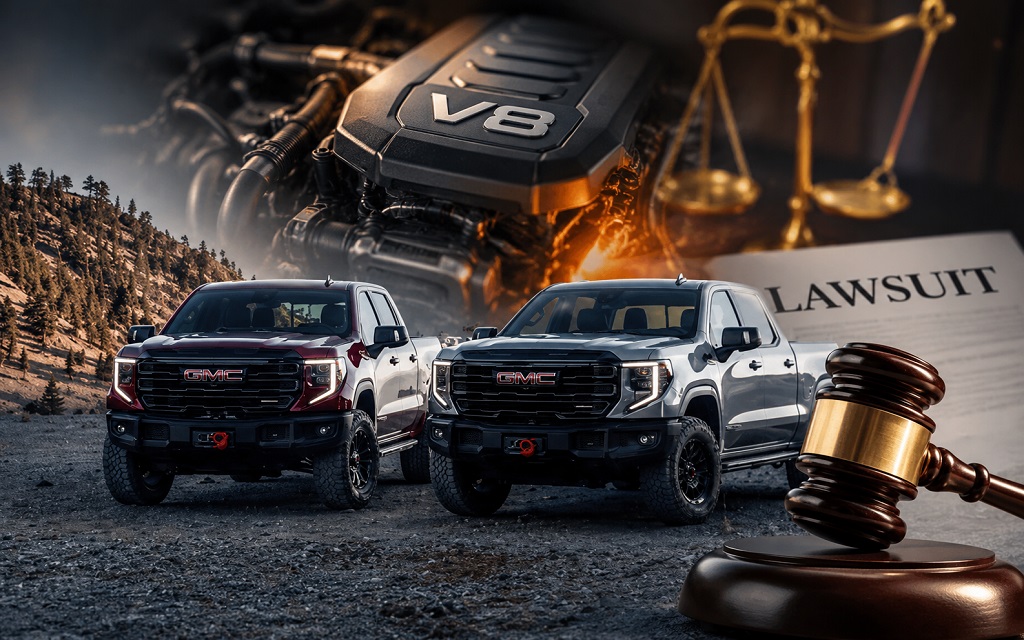
General Motors faces an active federal class action lawsuit over its 6.2-liter L87 V8 engine. The case, Powell et al. v. General Motors, LLC (Case No. 4:25-cv-10479-SDK-KGA, U.S. District Court, Eastern District of Michigan), covers 2019–2024 Chevrolet Silverado 1500 and GMC Sierra 1500 trucks, plus 2021–2024 Cadillac Escalade, Escalade ESV, Chevrolet Tahoe, Chevrolet Suburban, GMC Yukon, and Yukon XL models.
Owners allege that a bearing defect causes the crankshaft to lose lubrication, and the engine can seize with no warning. GM issued NHTSA recall 25V-274 in April 2025, but plaintiffs say the fix doesn’t correct the root defect. As of August 2026, GM has moved to dismiss the case, no class has been certified, and no settlement fund exists. This lawsuit is separate from GM’s older AFM/DFM lifter case and its already-settled 5.3L LC9 piston-ring case, both covered below.
What’s Verified vs. What’s Alleged
Court complaints contain allegations a jury or judge hasn’t ruled on yet. This article separates the two clearly:
- Verified facts — Court records, NHTSA files, and case dockets confirm these items: dates filed, case numbers, recall numbers, and vehicle lists.
- Plaintiff allegations — The lawsuit’s claims about why engines fail and why the recall falls short are legal allegations, not proven findings. GM has denied liability and moved to dismiss the case.
- No settlement has been reached in the L87 case. A site that claims otherwise, or that offers a “claim form” for this specific engine, either describes a different, already-settled GM case (see the LC9 section below) or is simply wrong.
What Is the GM V8 Engine Lawsuit?
“GM V8 engine lawsuit” actually refers to three distinct pieces of litigation, and a mix-up between them costs owners real time. The table below sorts each case by engine, status, and eligibility.
| Case | Engine | Model Years | Core Allegation | Current Status |
|---|---|---|---|---|
| Powell v. GM (the active 2026 case) | L87 6.2L V8 EcoTec3 | 2019–2024 Silverado/Sierra; 2021–2024 Escalade, Tahoe, Suburban, Yukon | Bearing/crankshaft defect causes sudden seizure | Active — motion to dismiss pending |
| Harrison v. GM (AFM/DFM lifters) | 5.3L, 6.0L, 6.2L (L83, L84, L87, L96) | 2014–present | Defective lifters cause knock, stall, cylinder-deactivation failure | Active — class certification motion pending |
| Siqueiros v. GM (LC9 piston rings) | 5.3L LC9 Vortec | 2011–2014 | Defective piston rings cause excess oil use and engine damage | Closed — $150M settlement paid, distribution underway |
The L87 Bearing Defect, Explained in Plain Terms
Every V8 engine depends on bearings to let the crankshaft spin under load without metal contact between the two parts. A thin film of pressurized oil does that job. The consolidated complaint alleges the L87’s bearings and crankshaft leave the factory outside proper tolerance, and that gap lets the oil film break down. The crankshaft can then contact the bearing directly once the film fails, and the friction that follows can seize the engine or push a connecting rod through the block.
Owners describe a strikingly consistent pattern in NHTSA complaint records: no dashboard alert, no rough idle, no gradual power loss. The truck or SUV simply loses power, often at highway speed, and the driver has only seconds to steer to safety. A subset of these incidents involved fires.
This section reflects allegations from the consolidated complaint. GM disputes the characterization and has moved to dismiss the case.
Affected Vehicles and Model Years
A vehicle needs the specific L87 6.2L V8 to fall under this lawsuit. The same body style sold with a smaller engine, or a diesel, sits outside the suit’s scope.
| Make | Model | Model Years |
|---|---|---|
| Chevrolet | Silverado 1500 | 2019–2024 |
| GMC | Sierra 1500 | 2019–2024 |
| Chevrolet | Tahoe | 2021–2024 |
| Chevrolet | Suburban | 2021–2024 |
| GMC | Yukon / Yukon XL | 2021–2024 |
| Cadillac | Escalade / Escalade ESV | 2021–2024 |
How to check your own vehicle: Look up the VIN on NHTSA’s recall lookup tool and search for recall number 25V-274, or ask a GM dealer to scan for the L87 engine code and diagnostic trouble code P0016. A confirmed L87 engine plus a model year in the table above generally places a vehicle within the lawsuit’s proposed class.
Case Timeline: How the L87 Lawsuit Reached 2026
- Jan. 16, 2025 — NHTSA opens a preliminary investigation into L87 engine failures after early owner complaints.
- April 24, 2025 — GM issues recall 25V-274. Reported figures vary by source, from roughly 598,000 to 721,000 vehicles, based on whether U.S.-only or global counts apply; NHTSA’s broader safety inquiry covers 877,710 vehicles.
- May 19, 2025 — Hagens Berman files the first major class complaint, Rittereiser v. General Motors, LLC, in the Eastern District of Michigan.
- June 24, 2025 — Plaintiffs file an amended complaint after owners report parts shortages and confusion over which recall branch applies to their vehicle.
- July 2025 — Additional suits follow in multiple states. One, filed in Wisconsin, claims GM knew of the defect well before the recalled model years began.
- July 31, 2025 — The court consolidates the related suits into a single case.
- Nov. 13, 2025 — Judge Shalina D. Kumar names Hagens Berman and three co-counsel firms, together called the “Miller Slate,” as interim class counsel.
- Feb. 26, 2026 — Plaintiffs file the consolidated 389-page complaint, now captioned Powell et al. v. General Motors, LLC, on behalf of 44 named owners.
- Jan. 2026 — NHTSA opens a second investigation for roughly 286,000 additional 2019–2021 vehicles, outside the original recall’s scope, after further failure reports surface post-repair.
- June 8, 2026 — GM files a motion to dismiss and points to its current recall as an adequate remedy.
- Present (Aug. 2026) — The motion to dismiss sits unresolved. No class has been certified. No settlement talks have been publicly confirmed.
NHTSA Recall 25V-274: What GM’s Fix Actually Does
GM’s recall runs a two-branch repair process, and which branch an owner gets depends on a single diagnostic step.
- Dealer scans for code P0016. A technician checks camshaft-to-crankshaft correlation.
- Full engine replacement. The dealer replaces the entire engine with either a new or remanufactured L87 unit, based on parts stock, whenever the scan returns code P0016.
- Oil and filter service. The dealer performs a smaller fix whenever the code doesn’t appear: drain the factory 0W-20 oil, refill with heavier 0W-40 Dexos R oil (the same spec used in the C8 Corvette Z06), and replace the oil filter and fill cap.
The repair costs nothing out of pocket for owners under an active recall. The dispute in court isn’t about cost. It’s about whether the oil-based branch of the fix actually solves anything.
Why Plaintiffs Say the Recall Falls Short
The consolidated complaint raises four specific objections to GM’s remedy, per the court record:
- Oil doesn’t fix a production tolerance problem. A thicker oil spec can reduce friction at the margins, but plaintiffs argue it can’t correct a crankshaft or connecting rod built outside spec in the first place.
- Replacement engines share the same design. Attorneys note that engines installed under the recall often come from the same L87 production line, so a “fixed” vehicle can still carry the same root defect.
- The inspection-first structure delays real repairs. A vehicle must fail the P0016 scan before it qualifies for full engine replacement, and plaintiffs say failures have struck shortly after a vehicle passed that same scan.
- Diminished value isn’t addressed at all. Even a properly repaired vehicle, plaintiffs argue, still carries a long resale-value hit tied to the defect’s publicity, and the recall offers no compensation for that loss.
GM disputes these characterizations in its motion to dismiss and maintains its recall constitutes an adequate remedy.
The Numbers Behind the Case
Figures below come directly from the consolidated complaint and NHTSA’s public complaint database:
- 877,710 vehicles fall under NHTSA’s original safety inquiry into the L87 engine.
- 28,102 complaints or field reports had reached GM by April 2025, per the lawsuit.
- 14,000+ of those reports describe a complete loss of propulsion.
- 1,157 bearing-failure reports sat with NHTSA by October 2025.
- 42 fires and 12 crashes tie back to the alleged defect, alongside 12 reported injuries.
- 286,000 additional 2019–2021 vehicles now sit under a second, separate NHTSA review opened in January 2026.
Is There a Settlement? Can I File a Claim Right Now?
No. As of August 2026, the L87 case has no certified class, no settlement agreement, and no claim form. A website that offers to “file your claim” for the L87 bearing defect today is either premature, focused on a different case, or set up to collect leads ahead of any real payout. Owners can still take protective steps now (see the checklist below), but formal compensation only becomes possible after class certification and, eventually, a settlement or trial verdict, a process that runs one to three years in comparable auto-defect litigation.
GM 5.3L LC9 Engine Settlement (Separate, Already Paid Out)
A different, older GM V8 case has reached a payout, and it’s worth covering here since search results often conflate it with the active L87 suit.
Siqueiros et al. v. General Motors, LLC (Case No. 3:16-cv-07244-EMC, U.S. District Court, Northern District of California) targeted the 5.3-liter LC9 Vortec engine in 2011–2014 Chevrolet Avalanche, Silverado, Suburban, Tahoe, and GMC Sierra, Yukon, and Yukon XL vehicles, sold or leased in California, Idaho, or North Carolina. Plaintiffs alleged defective piston rings caused excessive oil consumption and premature engine damage.
A jury returned a $102.6 million verdict in 2022, and the parties later negotiated a $150 million post-trial settlement, which Judge Edward M. Chen granted final approval on Oct. 2, 2025. Payment distribution to class members began Dec. 23, 2025, with average payouts reported around $2,149 to $3,300 per vehicle; the exact figure varies by source. Owners who already received a piston replacement under warranty were excluded.
This case is fully closed. No new claims can be filed against it.
GM AFM/DFM Lifter Lawsuit (Harrison v. GM) — The Other Active Case
A separate, active suit targets an entirely different part: the hydraulic lifters used in GM’s Active Fuel Management and Dynamic Fuel Management cylinder-deactivation systems. Harrison et al. v. General Motors LLC (Case No. 2:21-cv-12927-LJM-APP, Eastern District of Michigan) covers 2014 and newer Buick, Cadillac, Chevrolet, and GMC vehicles equipped with a 5.3L, 6.0L, or 6.2L V8 (engine codes L83, L84, L87, and L96). Plaintiffs allege the lifters use lightweight materials that wear prematurely, and GM’s design failed to account for thermal expansion between the lifters and the engine block. The result, per the complaint, is knock, stall, misfire, and power loss on the road. A motion for class certification, originally set for Dec. 1, 2025, has moved into 2026 and stays unresolved as of this update.
This case runs on a completely separate legal track from the L87 bearing suit, even though some model years and even some engine codes overlap.
What Should an Owner Do Right Now?
A vehicle on the affected list deserves a dealer visit for the P0016 scan regardless of the lawsuit’s outcome; that step addresses the immediate safety risk today. Beyond that:
- Save every service record and repair order tied to the engine. Recall paperwork counts too.
- Note the exact date and mileage if the engine has already shown knock, stall, or any unusual sound.
- Hold onto the vehicle if possible. A trade-in before a settlement can complicate a future claim.
- Register for NHTSA recall alerts with your VIN, so future notices arrive automatically.
- Watch for a formal class notice by mail once (and if) the court certifies a class; no legitimate notice will ever ask for payment upfront.
FAQs
Is my truck automatically part of the GM V8 lawsuit?
Ownership of an affected L87-equipped model and model year generally places a vehicle inside the proposed class described in the complaint. Formal class certification hasn’t happened yet, so the exact boundaries can still shift.
Does a completed recall repair remove me from the lawsuit?
No. A completed recall repair doesn’t waive a claim tied to diminished vehicle value or a defect plaintiffs say the repair fails to fully correct.
How much money will I get from the GM V8 engine lawsuit?
No figure exists yet. No settlement has been reached, and no class has been certified, so any specific dollar estimate that shows up online for the L87 case is speculation rather than fact.
What’s the difference between the L87 lawsuit and the AFM/DFM lifter lawsuit?
The L87 case targets a crankshaft-bearing defect in specific 2019–2024 full-size trucks and SUVs. The lifter case (Harrison v. GM) targets a different part across a wider span of model years (2014-present) and engine codes, and it proceeds as a fully separate lawsuit.
Can I still get compensation if I already sold my GM truck?
Some auto-defect settlements extend to former owners who held the vehicle during the alleged defect period, though eligibility rules vary by case and get finalized only once a settlement or judgment exists.
Where can I read the actual complaint?
The consolidated complaint and related filings are public court records, filed under the Powell et al. v. General Motors, LLC docket in the U.S. District Court for the Eastern District of Michigan.
Is the GM V8 engine lawsuit a recall or a lawsuit?
Both exist side by side and are legally distinct. NHTSA recall 25V-274 is a free safety repair GM must offer regardless of any lawsuit outcome. The lawsuit is a separate civil case that seeks added compensation plaintiffs say the recall doesn’t cover.
Summary
General Motors faces an active class-action lawsuit, Powell et al. v. General Motors, LLC, over its 6.2-liter L87 V8 engine, filed in the U.S. District Court for the Eastern District of Michigan. The suit covers 2019–2024 Chevrolet Silverado 1500 and GMC Sierra 1500, and 2021–2024 Cadillac Escalade, Chevrolet Tahoe, Chevrolet Suburban, and GMC Yukon models. Plaintiffs allege a crankshaft-bearing defect can cause sudden engine seizure with no warning. GM issued NHTSA recall 25V-274 in April 2025.
That recall gives owners a free engine replacement or an oil-service repair, and a diagnostic scan decides which one applies, but plaintiffs argue this remedy doesn’t fix the root defect. GM moved to dismiss the case on June 8, 2026. No class has been certified, and no settlement fund exists as of August 2026. This case stands apart from GM’s already-settled $150 million LC9 piston-ring settlement (Siqueiros v. GM) and its active AFM/DFM lifter lawsuit (Harrison v. GM). Independent reporting on the consolidated complaint is also available from CarComplaints.
Disclaimer: This article is for informational purposes only and does not constitute legal advice. Case details, figures, and status can change as litigation proceeds. Verify current status through official court dockets or NHTSA before making any decision about your vehicle. Last fact-checked: August 13, 2026.

Musarat Bano is a content writer for JudicialOcean.com who covers lawsuits, legal news, and general legal topics. Her work focuses on research-based, informational content developed from publicly available sources and is intended to support public awareness. She does not provide legal advice or professional legal services.