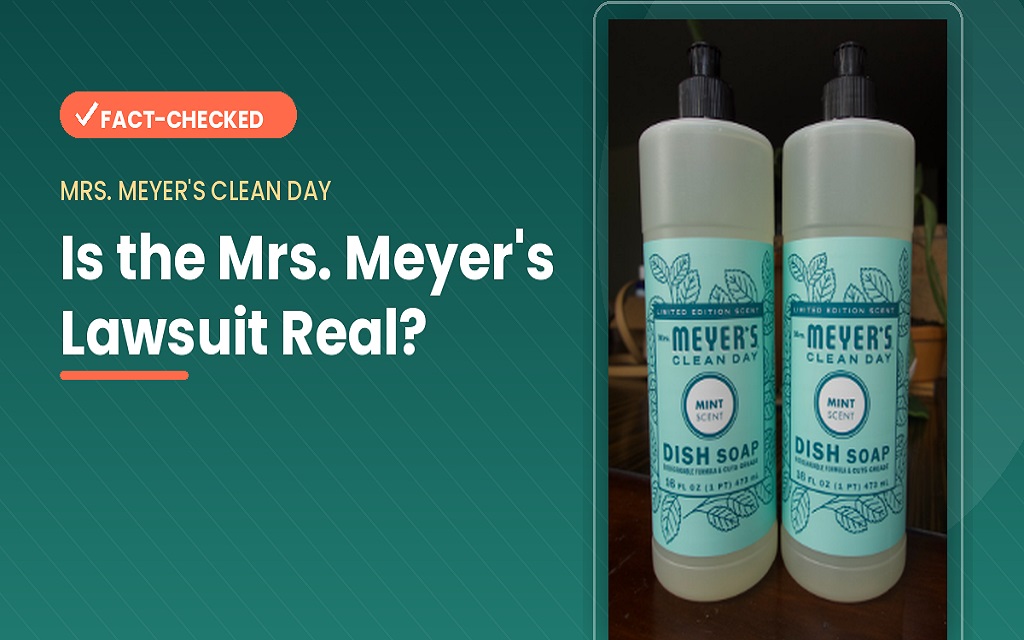
Mrs. Meyer’s Clean Day is a household cleaner brand. It should not get confused with Jennifer Meyers, a plaintiff in an unrelated 2018 lawsuit against a different company. That mix-up drives a lot of the confusion in this topic, so it’s worth saying plainly upfront. This guide breaks down what’s true, what’s unverified, and what the actual ingredients show.
Mrs. Meyer’s has one confirmed lawsuit. It happened in 2009. The case centered on 1,4-dioxane contamination in the brand’s dish soap. The company paid $50,000. It also had to test its products for a year. No verified active class action exists against Mrs. Meyer’s Clean Day today. A separate 2018 case confuses.
A plaintiff named Jennifer Meyers filed it. But the case targeted DERMA·E skincare products, made by Stearn’s Products, Inc. That company has no link to Mrs. Meyer’s Clean Day or its parent, S.C. Johnson. The rest of this guide covers what’s documented, what’s still unverified, and what the ingredients actually show. It also covers whether Mrs. Meyer’s dish soap is safe, the Caldrea Company’s lawsuit record, and how Mrs. Meyer’s stacks up against S.C. Johnson’s broader legal history.
A Timeline of the Confirmed Mrs. Meyers Lawsuit
The only real lawsuit against Mrs. Meyer’s dates back to 2009. David Steinman filed a civil complaint that year. He targeted the brand’s parent company, the Caldrea Company. The claim: Mrs. Meyer’s Clean Day Liquid Dish Soap contained 1,4-dioxane. This chemical sits on California’s Proposition 65 list because it can cause cancer. State law sets a hard limit for 1,4-dioxane. Proposition 65 allows just 10 parts per million. The original complaint, filed with the California Attorney General’s office, focused on levels that crossed this line.
The case ended with two clear results, laid out in the final judgment. Mrs. Meyer’s parent company paid $50,000. It also agreed to test its products for a full year. The goal: confirm 1,4-dioxane stayed under the legal limit, or add a clear warning label if it didn’t. Since then, bottles of Mrs. Meyer’s dish soap carry no Proposition 65 notice. This suggests the company lowered contamination levels or dropped the risk ingredient from that formula. That’s an inference, not a confirmed lab result. Treat it that way.
A second claim shows up online from time to time. It alleges Mrs. Meyer’s used synthetic ingredients while it marketed products as natural. Unlike the 2009 case, this allegation traces back to no filed case, no government record, and no FTC action anyone could confirm. Treat it as unconfirmed until a real source appears.
What the 2009 Lawsuit Actually Alleged
The chemistry behind the 2009 case matters more than the headline. Cleaner brands don’t add 1,4-dioxane on purpose. It forms as a byproduct during a production step called ethoxylation. Makers use this step to turn certain surfactants milder and more water-soluble. Some ingredients carry a risk of trace 1,4-dioxane. These include sodium laureth sulfate, ammonium laureth sulfate, polysorbates like Polysorbate 20, and other “eth”-named compounds such as laureth-6 and laureth-23.
At the time of the lawsuit, Mrs. Meyer’s dish soap contained Polysorbate 20. This ingredient falls into the at-risk group. That fact alone doesn’t prove the finished product crossed the Proposition 65 limit. Contamination levels shift based on the batch and the purification process a maker uses. Still, this link explains why regulators and plaintiffs’ attorneys built a case around the formula. Keep one distinction in mind: an ingredient that carries contamination risk differs from a product a lab has tested and confirmed to break a legal limit.
Fact-Check: The 2026 Mrs. Meyer’s Lawsuit Claims Online
A number of legal-content sites recently posted articles about an active 2026 class action against Mrs. Meyer’s. These articles allege deceptive “natural” labels. They cite specific ingredients: methylisothiazolinone, synthetic fragrance compounds, and sodium lauryl sulfate. Most include settlement estimate tables, payout ranges per claimant, and step-by-step claim instructions.
None of this holds up under a check. No court docket, case number, named plaintiff, or government record backs any of it. That gap counts as a real red flag, not a small detail. Here’s what likely happened instead: a genuine 2018 case exists. Meyers v. Stearn’s Products, Inc. went through the U.S. District Court for the Southern District of California, case number 3:18-cv-00557-DMS-NLS. The case closed in October 2018, when both sides reached a confidential settlement, and the court dismissed it. A plaintiff named Jennifer Meyers brought this suit. She targeted Stearn’s Products, Inc. over its DERMA·E skincare line.
The claim: DERMA·E products used the word “natural” on the label despite synthetic ingredients like phenoxyethanol, dimethicone, and zinc oxide. DERMA·E makes face and body care products. It has no owner link and no brand link to Mrs. Meyer’s Clean Day, S.C. Johnson, or the Caldrea Company. The shared surname looks like pure coincidence. Articles that describe “the Mrs. Meyers lawsuit 2026” likely mixed up these two cases, or they built speculative content around no real filed suit.
Did you see a headline about an active 2026 Mrs. Meyer’s class action with a claim deadline or a payout calculator? Question it. Check for a direct link to a real court record first, like a case record on PACER, the federal court system’s public access database. No such link exists in these cases, and the claim doesn’t either.
Is Mrs. Meyer’s Actually Safe? What the Ingredients Show
Mrs. Meyer’s makes several claims about what it leaves out. The brand says its products contain no ammonia, chlorine, parabens, phthalates, formaldehyde, artificial colors, phosphates, or petroleum distillates. Mrs. Meyer’s also lists its ingredients on the package, on its website, and on a glossary page. That level of openness puts it ahead of many conventional cleaner brands, which disclose far less.
Even so, every Mrs. Meyer’s product lists the word “fragrance” as one ingredient. Current label law lets brands bundle hundreds of compounds under that single term without a full list. The brand offers no fragrance-free line right now. Ask whether Mrs. Meyer’s dish soap is safe for daily use, and the fragrance question is the biggest variable. It matters more than the cleaner formula itself.
Two ingredient groups draw the most scrutiny. The first: a pair of preservatives, methylisothiazolinone and benzisothiazolinone. Some Mrs. Meyer’s products contain them; others don’t. Independent research links both to allergic reactions. Repeat exposure can trigger a reaction even in people who showed no response the first few times. EWG’s Skin Deep database tracks consumer-product ingredients like these and their reported hazard concerns, and it’s a useful cross-reference if you want to check a specific formula.
People with eczema or other skin issues should stay cautious around these preservatives, no matter the brand. The second group: ethoxylated ingredients, the same surfactant family tied to the 2009 lawsuit. These carry a production-related risk of trace 1,4-dioxane or ethylene oxide contamination. Both compounds count as recognized carcinogens at high enough exposure.
| Ingredient category | Function | Documented concern | Present in all products? |
|---|---|---|---|
| Fragrance (undisclosed blend) | Scent | Can contain allergens; full mix not disclosed | Yes |
| Methylisothiazolinone / Benzisothiazolinone | Preservative | Allergen and skin irritant risk | No — absent from some lines, e.g., Lavender hand soap |
| Ethoxylated surfactants (e.g., Polysorbate 20, laureths) | Cleans and emulsifies | Production byproduct risk: 1,4-dioxane contamination | Varies by product |
| Essential oils/plant extracts | Scent, brand identity | Can trigger allergic reactions in sensitive people | Common but not universal |
FTC Green Guides vs. Mrs. Meyer’s Label Language
The FTC’s Green Guides set truth-in-advertising standards for environmental marketing terms like “eco-friendly” and “biodegradable.” The guides themselves don’t specifically define the word “natural.” Separately, the FTC has brought enforcement actions under its general deceptive-advertising authority against brands that use an unqualified “all natural” claim while a product contains synthetic ingredients. Either way, an environmental or natural-sounding claim needs proof a reasonable buyer would understand. Mrs. Meyer’s labels lean on phrases like “garden-inspired scents” and “made with essential oils and other thoughtful, plant-derived ingredients.”
Neither phrase makes a flat “100% natural” claim. That gap likely explains why the brand hasn’t faced the kind of label suit that hit its sister brand, Method — filed in 2016 and settled in 2017 over similar green claims — or the suit that hit DERMA·E in 2018. This context matters for anyone who researches S.C. Johnson’s broader lawsuit history. Method’s case often gets cited alongside Mrs. Meyer’s in roundups of household-brand greenwashing claims, even though the two brands faced very different outcomes.
Here’s the real gap: the space between literal truth and overall impression. “Garden-inspired” stays technically true no matter what’s in the bottle, since inspiration isn’t a chemical claim. Does that kind of language create a false overall impression in a reasonable buyer’s mind? That’s the actual legal test courts apply in these cases. No court has tested that question against Mrs. Meyer’s specifically, at least not in any confirmed case so far.
Reported Consumer Reactions: Anecdote vs. Verified Claim
Beyond the legal record, some buyers describe bad reactions to Mrs. Meyer’s products. These show up in public reviews and comment sections. People report skin irritation, airway irritation, and allergy-type responses after they use scented sprays or multi-surface products.
These reports stay anecdotal. No peer review backs them. No independent check confirms them. They don’t count as a legal claim or proof of a real pattern. That said, they line up with the known allergy and irritant traits of isothiazolinone preservatives and undisclosed fragrance mixes covered above.
That context matters. Still, a handful of self-reported reactions in a comment section sits in a different evidence class than a lab-confirmed contamination result or a court judgment. Do you react to any household product? Stop use right away and talk to a doctor. That step matters more than what the label says.
If a Real Settlement Ever Happens: What a Claim Would Involve
No verified active settlement exists for Mrs. Meyer’s right now. So there’s nothing to claim today. But real, confirmed cases give a solid guide. Look at the 2018 DERMA·E label case and the 2016–2017 Method lawsuit and settlement over green claims. A real Mrs. Meyer’s settlement would likely follow a familiar path. First, a court must certify a class. A judge decides the claims share enough common ground across buyers to move forward together.
Next, a claims administrator sets up an official site. Eligible buyers then get a set window, often two to four months, to send in a claim. Proof of purchase helps: receipts, order records, anything that shows you bought the product. Save your digital purchase records now. That step costs nothing and puts you in a stronger spot if a real settlement gets court approval later. Want to confirm whether a real settlement exists? Search the case name straight on PACER or a court’s own docket system. Skip the third-party summary sites.
Mrs. Meyer’s vs. Other Household Cleaner Brands
| Brand | Fragrance-free option | Third-party natural certification | Known lawsuit history |
|---|---|---|---|
| Mrs. Meyer’s | No | None (Leaping Bunny cruelty-free only) | One confirmed case, 2009 |
| Seventh Generation | Yes | EPA Safer Choice certified on select lines | None confirmed |
| Branch Basics | Yes (fragrance-free by default) | MADE SAFE Certified, EWG Verified | None confirmed |
| Method | No | None | 2016 lawsuit, settled 2017 |
FAQs
Was Mrs. Meyers actually sued?
Yes. In 2009, a suit hit Mrs. Meyer’s parent company, the Caldrea Company. The claim centered on 1,4-dioxane levels in its dish soap under California’s Proposition 65 law. The case ended with a $50,000 payment and a year of required product tests.
Is there a Mrs. Meyer’s lawsuit in 2026?
No. No court docket or government source confirms an active class action against Mrs. Meyer’s right now. Articles that describe a 2026 settlement look unverifiable. They likely stem from mixed-up reports about a separate, unrelated 2018 case against DERMA·E, a different brand entirely.
Who owns Mrs. Meyer’s?
Mrs. Meyer’s runs under the Caldrea Company. S.C. Johnson & Son has owned Caldrea since 2008.
Does Mrs. Meyer’s kill germs?
No. Mrs. Meyer’s products count as soaps, not disinfectants. They remove germs and dirt through wipe-and-rinse action, not through a kill-on-contact effect. The CDC draws this same line for hand hygiene: sanitizers kill germs, while soap and water remove them. The CDC recommends handwashing over sanitizer whenever soap and water are available, since a wash removes a wider range of germ types than a sanitizer kills. That puts soap-based cleaners in a separate category from EPA-registered disinfectants.
Is Mrs. Meyer’s dish soap safe?
Mostly, yes, for typical household use. It skips several common toxins, and its main 2009 contamination concern hasn’t reappeared in a Proposition 65 notice since. Still, some ingredients carry documented allergy risk, so people with sensitive skin or fragrance allergies should check the label first.
Is Mrs. Meyer’s non-toxic?
Not fully. No third-party group certifies it that way. Mrs. Meyer’s does skip several common toxins: phthalates, parabens, and formaldehyde. Still, some ingredients carry real risk. Undisclosed fragrance compounds and isothiazolinone preservatives both have documented allergy and sensitizer links.
Summary
Mrs. Meyer’s Clean Day has one confirmed lawsuit. Filed in 2009, the case alleged the brand’s dish soap contained 1,4-dioxane above California’s Proposition 65 limit of 10 parts per million. The Caldrea Company, Mrs. Meyer’s parent, paid $50,000 and agreed to a year of product tests. No active class action against Mrs. Meyer’s exists today, based on public court and PACER records.
A separate, unrelated 2018 case, Meyers v. Stearn’s Products, Inc. (Case No. 3:18-cv-00557-DMS-NLS), targeted DERMA·E skincare over natural-label claims. That case closed in October 2018 with a confidential settlement and has no link to Mrs. Meyer’s Clean Day, the Caldrea Company, or S.C. Johnson. S.C. Johnson & Son has owned Mrs. Meyer’s through the Caldrea Company since 2008. Mrs. Meyer’s carries Leaping Bunny cruelty-free and vegan certification but no third-party natural or organic certification.
Sources
- California OAG — 2009 Proposition 65 Complaint (2009-00167C1448)
- California OAG — 2009 Case Record: Settlement & Judgment (AG No. 2009-00167)
- California Prop 65 Warnings — 1,4-Dioxane Fact Sheet
- Meyers v. Stearn’s Products, Inc. — Class Action Complaint, Case No. 3:18-cv-00557-DMS-NLS
- Truth in Advertising — DERMA·E Case Tracker (dismissal and settlement record)
- Top Class Actions — Method/Ecover Natural Products Settlement

Musarat Bano is a content writer for JudicialOcean.com who covers lawsuits, legal news, and general legal topics. Her work focuses on research-based, informational content developed from publicly available sources and is intended to support public awareness. She does not provide legal advice or professional legal services.