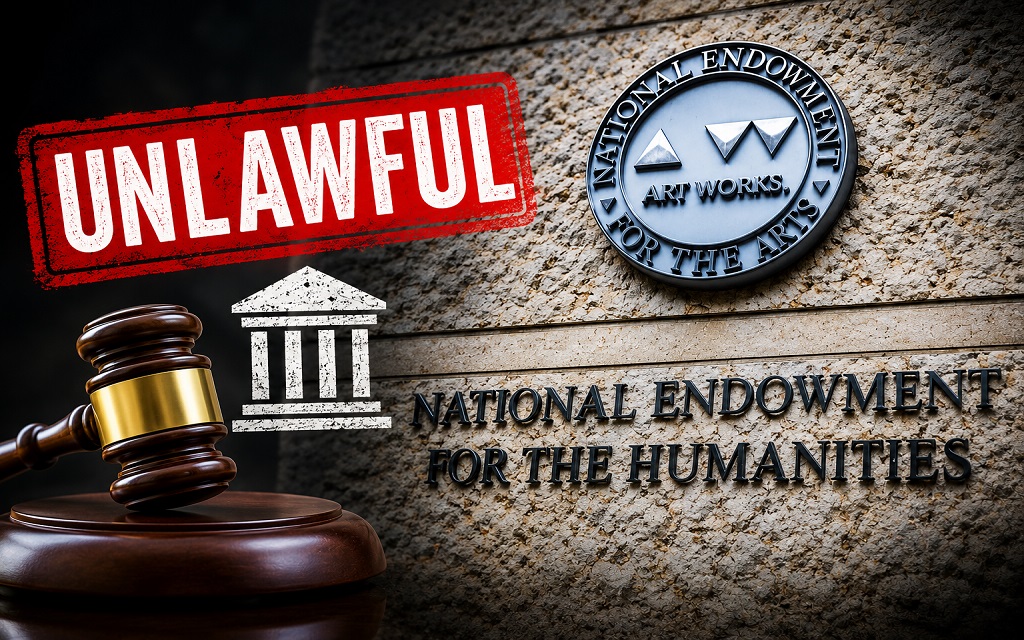
A federal judge ruled that the mass termination of more than 1,400 National Endowment for the Humanities (NEH) grants was unlawful, finding that federal officials lacked sufficient legal authority to cancel congressionally approved funding.
The case, widely referred to as the Humanities Grants Elimination Lawsuit, involves more than $100 million in federal humanities funding and raises significant questions about executive authority, constitutional protections, federal grant oversight, and the use of AI-assisted review processes.
| Question | Answer |
|---|---|
| What happened? | More than 1,400 NEH grants were terminated during a large-scale funding review. |
| How much funding was affected? | More than $100 million. |
| Who filed the lawsuit? | Humanities organizations, scholars, grant recipients, and related institutions. |
| What did the court decide? | The court ruled that the grant terminations were unlawful. |
| What constitutional issues were raised? | First Amendment, Fifth Amendment, and congressional spending authority concerns. |
| Can the government appeal? | Yes. |
| Why does this matter? | The ruling could affect future federal grant programs across multiple agencies. |
Key Takeaways
- A federal court ruled that the humanities grants elimination effort violated federal law.
- More than 1,400 grants funded through the National Endowment for the Humanities lost funding.
- The court found serious concerns regarding constitutional protections and agency authority.
- Questions emerged regarding AI-assisted grant review methods.
- The decision reinforces Congress’s constitutional role in controlling federal spending.
- The ruling could influence future disputes involving research funding, educational grants, and federal agency decision-making.
Why the Humanities Grants Elimination Lawsuit Matters
This lawsuit extends beyond humanities funding.
The case addresses a fundamental constitutional question: Can executive branch officials broadly terminate grants that Congress has already approved and funded?
The court’s answer was largely no.
The decision may affect how federal agencies administer grants involving:
- Education
- Scientific research
- Historical preservation
- Healthcare initiatives
- Public policy programs
- Cultural institutions
- Community development projects
The ruling also contributes to an emerging legal debate regarding artificial intelligence and automated decision-making within government agencies.
Case Summary
| Item | Details |
|---|---|
| Case Type | (Federal grant funding dispute) Humanities Grants Elimination Lawsuit |
| Agency | National Endowment for the Humanities |
| Grants Affected | 1,400+ |
| Funding | $100M+ |
| Main Issues | First Amendment, Fifth Amendment, Congressional Authority, Administrative Law Compliance |
| Court Result | Grant terminations ruled unlawful |
| Appeal Possible | Yes |
What Happened in the Humanities Grants Elimination Lawsuit?
The controversy began when federal officials terminated more than 1,400 active grants funded through the National Endowment for the Humanities.
The affected grants supported a wide range of projects, including:
- Museum preservation initiatives
- Library digitization programs
- Historical archives
- Academic research
- Educational outreach efforts
- Public humanities projects
Many recipients had already begun work when termination notices arrived.
Some organizations had hired staff, signed contracts, launched public programs, or invested substantial resources based on approved federal funding.
Plaintiffs argued that the government lacked legal authority to terminate such a large number of congressionally funded grants without following established legal procedures.
The resulting litigation became one of the most significant federal humanities funding disputes in recent years.
Why Were the NEH Grants Terminated?
Federal officials stated that the grant terminations formed part of a broader review of federal spending and agency priorities.
According to government explanations, some funded projects are no longer aligned with revised policy objectives.
As a result, grant recipients received notices informing them that previously approved funding would be terminated.
However, plaintiffs argued that policy disagreements do not provide sufficient legal grounds for canceling grants that Congress had already authorized and funded.
The lawsuit ultimately focused on whether executive branch officials possessed the legal authority to take such broad action.
Who Filed the Humanities Grants Elimination Lawsuit?
The plaintiffs included a broad coalition of organizations and individuals connected to the humanities sector.
Participants included:
- Humanities organizations
- Scholars and researchers
- State humanities councils
- Educational institutions
- Grant recipients
- Cultural preservation groups
The plaintiffs argued that the cancellations exceeded federal authority and violated constitutional protections.
They also emphasized the practical impact on communities that depended on federally funded educational and cultural programs.
What Makes This Lawsuit Unusual?
Several factors distinguish this case from ordinary grant disputes.
Extraordinary Scale
More than 1,400 grants lost funding.
Federal agencies occasionally terminate individual grants. Large-scale cancellations involving thousands of awards are far less common.
Constitutional Claims
The lawsuit involved multiple constitutional issues, including free speech and due process protections.
Congressional Spending Authority
The dispute directly challenged the relationship between executive agencies and Congress’s constitutional power to control federal spending.
Artificial Intelligence Questions
Court records and public reporting raised concerns regarding AI-assisted review processes used during grant evaluations.
National Impact
The outcome may influence grant administration practices across numerous federal agencies.
Judge’s Findings
The federal court ruled that the mass termination of National Endowment for the Humanities (NEH) grants was unlawful because the government failed to provide sufficient legal authority and justification for the cancellations.
| Issue | Court’s Finding |
|---|---|
| Grant Terminations | Unlawful |
| Legal Authority | Insufficient justification provided |
| Constitutional Concerns | Significant concerns identified |
| Congressional Funding | Must be respected by federal agencies |
| Outcome | Court ordered relief for affected grant recipients |
The judge found that federal officials exceeded the limits of their authority when terminating more than 1,400 congressionally funded humanities grants. The court concluded that agencies must follow federal law, respect congressional appropriations, and provide lawful reasons before withdrawing approved funding.
The ruling also addressed constitutional concerns involving free speech, due process, and executive authority. As a result, the court ordered corrective action and reinforced the principle that federal agencies must operate within the authority granted by Congress.
First Amendment Analysis
Plaintiffs’ Argument
Plaintiffs argued that some grants were targeted because of the viewpoints, subject matter, or perspectives reflected in funded projects.
The First Amendment generally prohibits government officials from discriminating against protected speech based on viewpoint.
According to the lawsuit, the cancellation effort reflected ideological preferences rather than neutral administrative standards.
Court Findings
The court identified substantial concerns regarding viewpoint discrimination.
The judge examined whether the government relied on lawful administrative criteria or impermissible considerations related to protected expression.
Those constitutional concerns became an important component of the ruling.
Potential Impact
The decision may reinforce protections for organizations that receive federal funding while engaging in educational, cultural, or scholarly work involving protected speech.
Fifth Amendment Analysis
Plaintiffs’ Argument
Plaintiffs argued that grant recipients lost funding without adequate explanations or fair procedures.
Many recipients reportedly received nearly identical termination notices.
According to the lawsuit, those notices failed to provide meaningful project-specific justification.
Court Findings
The court identified significant due process concerns.
The judge examined whether recipients received fair treatment and whether agencies followed required legal procedures before withdrawing previously approved funding.
Potential Impact
The ruling may encourage federal agencies to provide more detailed documentation and individualized review procedures in future grant decisions.
Congressional Spending Authority Analysis
Congress controls federal spending through its constitutional appropriations power.
This issue became central to the Humanities Grants Elimination Lawsuit.
Plaintiffs argued that Congress had already approved and funded the grants at issue.
The court largely agreed that agencies must operate within limits established by federal law and congressional appropriations.
The ruling reinforces a longstanding constitutional principle:
Congress determines how federal funds are allocated, and executive agencies must administer those funds according to the law.
DOGE Authority Questions
The Department of Government Efficiency (DOGE) also became a significant issue during litigation.
Plaintiffs argued that DOGE participated in efforts related to grant review and termination decisions.
The court examined whether officials involved in the review process possessed the legal authority necessary to influence grant administration decisions.
The ruling raised broader questions regarding interagency involvement in programs administered by separate federal entities.
Although federal agencies frequently cooperate, courts generally require agencies to remain within the authority granted by Congress.
AI and Government Decision-Making
One of the most closely watched aspects of the Humanities Grants Elimination Lawsuit involved artificial intelligence.
Court records and public reports suggested that AI-assisted tools may have played a role during portions of the grant review process.
The litigation did not establish that AI systems made final funding decisions.
However, concerns emerged regarding:
- Automated evaluations
- Document analysis
- Grant categorization
- Recommendation systems
- Transparency and accountability
The case highlights a growing national discussion about the appropriate role of artificial intelligence in government decision-making.
As federal agencies increasingly adopt AI tools, courts may require stronger safeguards, greater transparency, and meaningful human oversight.
How Many Grants Were Affected?
More than 1,400 grants funded by the National Endowment for the Humanities (NEH) were terminated, affecting over $100 million in federal humanities funding.
Key Facts
| Metric | Details |
|---|---|
| Grants Terminated | 1,400+ |
| Funding Affected | $100 million+ |
| Agency Involved | National Endowment for the Humanities (NEH) |
| Impacted Organizations | Museums, libraries, universities, humanities councils, and researchers |
The Humanities Grants Elimination Lawsuit involves one of the largest grant cancellation efforts in NEH history. Many recipients had already launched projects, hired staff, or committed resources before funding was terminated.
The large scale of the cancellations became a central issue in the lawsuit. Plaintiffs argued that the grants were eliminated through a broad government action rather than individual project reviews. The court considered that argument when evaluating the legality of the terminations.
The size of the funding cuts and the number of affected grants helped make the case a nationally significant dispute over federal grant authority and congressional spending power.
Organizations Affected by the Grant Terminations
The funding cancellations affected museums, libraries, universities, humanities councils, and researchers across the United States. Many projects had already hired staff, launched programs, or committed funding before grant terminations occurred.
Museums
Many museums relied on NEH funding to preserve collections, digitize archives, and create public exhibitions.
Libraries
Libraries used grants to support historical preservation projects, archival initiatives, and public education programs.
Universities
Universities depended on funding for research projects, scholarly initiatives, and public humanities programs.
State Humanities Councils
Humanities councils used federal support to provide educational opportunities, public programming, and community engagement initiatives.
Researchers
Individual scholars relied on grants to conduct long-term research involving history, literature, culture, and public scholarship.
What Happens Next?
The court’s ruling does not automatically end the dispute.
Federal officials must determine how they will respond to the decision and whether terminated funding will be restored.
Many affected organizations expect corrective action.
However, implementation may require additional administrative review and legal proceedings.
Can the Government Appeal?
Yes.
The federal government generally has the right to appeal adverse federal court rulings.
An appeal would allow a higher court to review the legal conclusions reached by the trial court.
Potential appellate issues could include:
- Constitutional interpretation
- Administrative authority
- Appropriations law
- Federal grant administration standards
Until any appeal is resolved, uncertainty may remain regarding the long-term outcome.
Timeline of the NEH Grant Litigation
The litigation developed through several important stages that shaped the outcome of the case.
| Stage | Expected Development |
|---|---|
| Immediate | Agencies review court order |
| Short Term | Evaluation of affected grants |
| Next Phase | Possible restoration of funding |
| Appeal Window | The government may seek appellate review |
| Long Term | Potential policy revisions regarding grant administration |
| Future Impact | Increased scrutiny of large-scale funding cancellations |
FAQs
What is the humanities grants elimination lawsuit?
The Humanities Grants Elimination Lawsuit refers to legal challenges arising from the mass termination of more than 1,400 National Endowment for the Humanities grants.
How much funding was affected?
The dispute involves more than $100 million in federal humanities funding.
How many grants were terminated?
More than 1,400 grants lost funding.
What did the judge decide?
The court ruled that the mass grant terminations were unlawful.
Why is the case important?
The case addresses constitutional protections, congressional spending authority, federal agency powers, and the role of AI-assisted decision-making in government.
Can the ruling affect other agencies?
Potentially yes. The decision may influence future grant administration practices across multiple federal programs.
What is DOGE?
DOGE refers to the Department of Government Efficiency, an entity that reportedly participated in efforts connected to the grant review process.
Expert Analysis
The Humanities Grants Elimination Lawsuit represents far more than a dispute over humanities funding.
The case tests the limits of executive authority, reinforces Congress’s constitutional spending role, and highlights growing concerns regarding automated decision-making within government institutions.
The ruling signals that federal agencies must provide clear legal authority when attempting broad funding cancellations involving congressionally approved programs.
The decision also reflects increasing judicial scrutiny of transparency, accountability, and procedural fairness in federal administration.
For researchers, nonprofit organizations, educational institutions, and public agencies, the case may become an important precedent in future disputes involving federal funding and administrative authority.
Why This Ruling Matters
The Humanities Grants Elimination Lawsuit is not just about humanities funding. The ruling could influence how federal agencies manage grants, use AI tools, and exercise authority over congressionally approved funding.
Key Impacts
- Limits Executive Authority: Federal agencies may need stronger legal justification before canceling grants that Congress has already funded.
- Protects Grant Recipients: Universities, museums, libraries, nonprofits, and researchers could gain stronger protections against sudden funding terminations.
- Raises AI Oversight Questions: The case highlights growing concerns about AI-assisted decision-making in government and the need for transparency and human review.
- Reinforces Congressional Power: The ruling confirms that Congress controls federal spending, while agencies must operate within the authority granted by law.
- Potential Nationwide Impact: The decision could affect grant administration across education, science, healthcare, infrastructure, and community development programs.
Conclusion
The humanities grants elimination lawsuit has become one of the most consequential federal funding disputes in recent years.
A federal judge concluded that the mass termination of more than 1,400 National Endowment for the Humanities grants violated legal standards governing federal agencies. The ruling raises important questions involving constitutional protections, congressional authority, administrative law, and the future role of artificial intelligence in government decision-making.
Although appeals remain possible, the decision already reinforces a central constitutional principle: federal agencies must operate within the authority granted by Congress when administering public funds. As future disputes emerge involving grants, research funding, and AI-assisted government processes, the Humanities Grants Elimination Lawsuit may serve as a significant legal and policy benchmark.

Musarat Bano is a content writer for JudicialOcean.com who covers lawsuits, legal news, and general legal topics. Her work focuses on research-based, informational content developed from publicly available sources and is intended to support public awareness. She does not provide legal advice or professional legal services.