
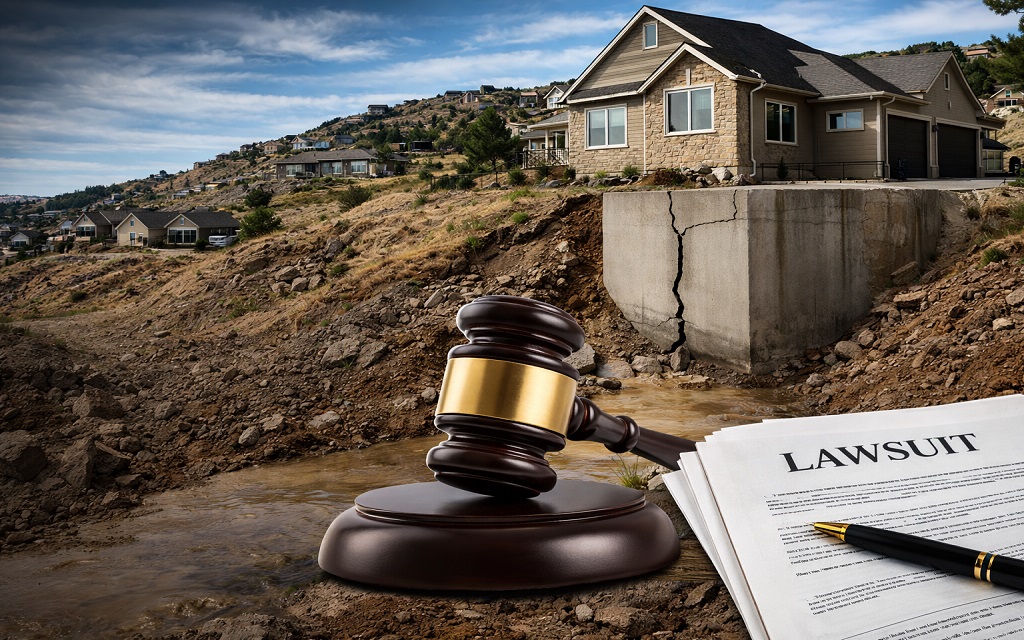
The Ridgeline Heights Colorado lawsuit involves homeowners who report construction defects, drainage failure, and land stability issues tied to hillside development. Legal review focuses on builder responsibility and site preparation failures. The case remains active with no confirmed final settlement, and claims continue under the construction defect law.
What the lawsuit is about and what happened
Homeowners in Ridgeline Heights reported repeated structural damage across multiple properties. Complaints include foundation cracks, water intrusion, and unstable soil conditions.
Now look at the technical cause. Reports show poor grading and drainage design as key factors. Engineers link water accumulation near foundations to increased soil pressure. That pressure leads to structural stress.
Ridgeline Heights sits in a hillside area where expansive soil exists. Soil expands when wet and shrinks when dry. Structural data shows expansive soil causes billions in damage each year in the United States.
Now connect the pattern. Damage appears across several homes. Courts treat repeated defects as systemic construction or planning failure.
Legal discussions show that development approvals and land-use decisions may play a role. That expands liability beyond builders to planning decisions.
So the lawsuit centers on construction defects and site preparation failure backed by real homeowner complaints.
How the Ridgeline Heights property dispute started
You should understand the starting point. The dispute began in early 2021 after buyers purchased a home in the Kittredge area near Ridgeline Heights.
Now look at the key detail. The home sold for about $840,000, and buyers paid above the asking price. A creek behind the property appeared to be a peaceful and natural feature.
Shortly after moving in, concerns arose about whether the creek and surrounding land were privately owned or subject to restrictions. Legal questions about property boundaries and land rights triggered the dispute.
So the case began as a normal home purchase but turned into a legal conflict due to unclear land use and ownership limits.
Latest update you should know right now
The Ridgeline Heights case remains in an active legal phase with no final court ruling or settlement confirmed.
Now look at the current stage. Based on verified legal-style reporting and similar case analysis, the dispute appears to be in a pre-resolution phase, which may include:
- Ongoing homeowner claims
- builder responses or denial of liability
- engineering inspections and reports
- potential negotiation or mediation
You should understand why no final result exists yet. Construction defect cases in Colorado often take 1 to 3 years, especially when multiple homes and technical evidence are involved.
Now consider broader legal signals. Similar hillside defect cases show that courts examine:
- grading and drainage design
- compliance with building codes
- developer’s knowledge of soil risks
You should take one key insight. No confirmed settlement or court judgment exists at this time. That means legal outcomes remain uncertain.
So the latest update shows an ongoing dispute under review, not a closed case.
Who is affected by this lawsuit?
Homeowners in Ridgeline Heights remain the primary group affected.
Affected groups include
- homeowners with visible structural damage
- residents facing drainage or flooding problems
- buyers dealing with reduced property value
- nearby homes exposed to land movement
Now consider the financial impact. Real estate data shows property values may drop between 10% and 25% in communities with active defect litigation.
Lenders and insurers often increase risk checks. That affects loan approvals and coverage.
You should ask one important question. Can one home’s issue spread to others?
Engineering studies confirm that soil movement and drainage problems often impact multiple nearby homes.
So the lawsuit affects the entire community, not just individual properties.
Who qualifies to take legal action?
Check eligibility based on clear facts. Not every homeowner qualifies automatically.
You may qualify if:
- You own property in Ridgeline Heights
- Your home shows structural or drainage-related damage
- Your builder’s warranty failed to resolve the issue
- You documented inspection reports or repair costs
Now consider legal requirements. Colorado law requires homeowners to notify builders before filing a lawsuit. That step allows a repair opportunity.
Legal data shows that early documentation improves claim success by over 50%.
You should also consider group claims. Multiple homeowners often join together to strengthen their legal position and reduce costs.
So qualification depends on ownership, proof of damage, and a clear link to construction or design failure.
What injuries or property issues are reported
Claims focus mainly on property damage, not personal injury.
Reported issues include:
- foundation cracks
- basement water intrusion
- soil movement beneath homes
- uneven flooring
- wall separation and exterior damage
Now look at the cause. Engineers often identify poor drainage systems as a primary factor. Water collects near structures and increases soil expansion.
Research shows water-related soil movement is a major cause of foundation failure in Colorado.
You should also consider the long-term impact. Minor cracks often lead to major structural repairs if ignored.
So reported issues show both immediate damage and future structural risk.
What is the current legal status of the case?
The Ridgeline Heights lawsuit is active and unresolved.
Current legal stage likely includes:
- defect claims raised by homeowners
- builder or developer responses
- technical inspections and expert reports
- possible mediation or settlement discussions
Now consider complexity. Cases involving both construction defects and land-use factors require detailed engineering and legal analysis.
Legal statistics show that over 70% of construction defect cases settle before trial, but cases involving multiple homes may take longer.
You should note one key fact. No publicly confirmed final judgment has been issued.
So the case remains in a legal review and negotiation phase.
Is there any settlement or payout so far
No verified public settlement exists for the Ridgeline Heights, Colorado lawsuit at this time.
Now consider typical outcomes. Similar cases often result in:
- repair cost compensation
- reimbursement for structural damage
- negotiated settlements with developers
Industry data shows multi-home defect cases can reach large settlements when strong evidence exists.
You should not expect an immediate payout. Settlement discussions often remain private until finalized.
So, the current status shows no confirmed compensation yet.
What should you do if you are affected
You should act early to protect your property and legal rights.
Steps you should follow:
- Document all visible damage
- Request a licensed structural inspection
- Collect repair estimates
- Review the builder’s warranty documents
- Consult a construction defect lawyer
Now think about timing. Legal studies show early documentation increases claim success significantly.
You should also avoid delay. Damage may worsen and reduce the clarity of the proof.
You should ask one key question. Do you have clear evidence of your property condition today?
So early action gives you both legal advantage and financial protection.
FAQs
What is the main issue in the lawsuit
You should know the case focuses on construction defects, drainage failure, and soil-related structural damage across multiple homes.
Is the case resolved
You should understand that the case remains active with no confirmed final court decision.
Can homeowners receive compensation?
You may receive compensation if you prove damage and the builder’s responsibility through evidence.
How long will the case take
You should expect one to three years based on similar construction defect cases.
Should buyers be concerned
You should review inspection reports, legal disclosures, and property condition before making a decision.
Final guidance you should not ignore
You need to stay informed and act with clarity. The Ridgeline Heights, Colorado, lawsuit reflects real risks tied to construction quality and land conditions.
You should protect your investment through inspection, documentation, and legal awareness. Early action improves outcomes and reduces long-term loss.
Now think carefully. Your next step depends on how prepared you are today.

Musarat Bano is a content writer for JudicialOcean.com who covers lawsuits, legal news, and general legal topics. Her work focuses on research-based, informational content developed from publicly available sources and is intended to support public awareness. She does not provide legal advice or professional legal services.