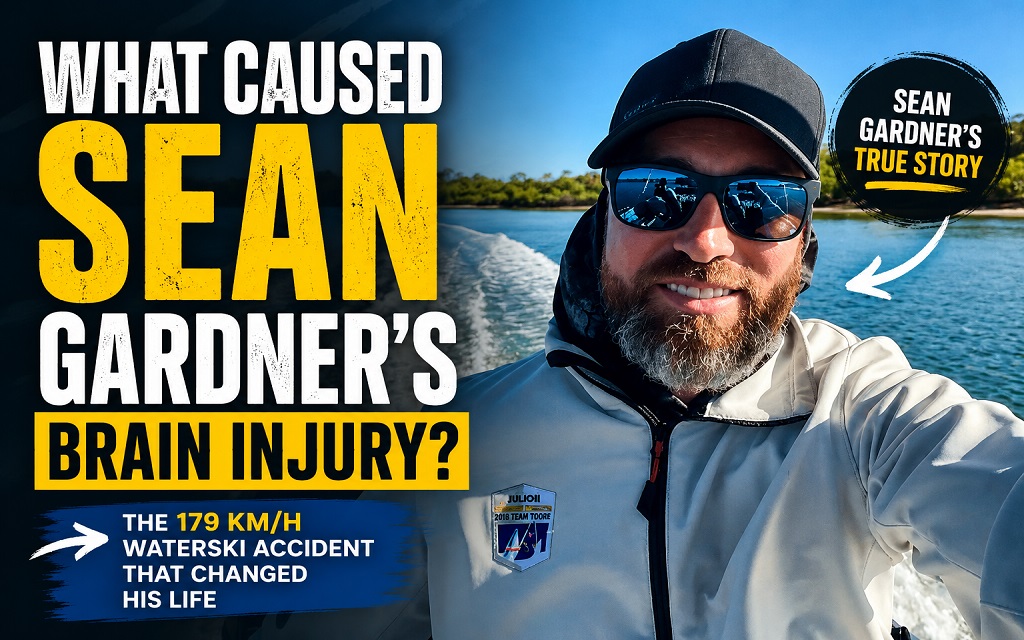
Many people search for one clear answer. What caused Sean’s brain injury?
The answer relates to Sean Gardner, a Gold Coast man and competitive waterski racer. Sean suffered a traumatic brain injury after a high-speed waterski training accident in New Zealand in 2019. The crash happened one day before a race. He fell while skiing at about 179 km/h. Sean later described the impact as feeling like he had hit concrete.
The accident caused several life-threatening injuries. Sean suffered bleeding on the brain, a brain injury, spine and rib fractures, a collapsed lung, ruptured neck tendons, and a skull-spine dislocation. He needed six hours of emergency surgery.
Sean’s story matters because it shows how fast a normal life can change after brain trauma. It also shows why recovery from a traumatic brain injury, often called a TBI, can involve far more than physical healing. Brain injury recovery can affect speech, movement, memory, work, mood, identity, and family life.
This article explains what caused Sean Gardner’s brain injury, how the waterski accident happened, what injuries he suffered, and how he rebuilt his life after trauma. It also explains traumatic brain injury in simple medical terms.
Key Facts
- Sean crashed during waterski training.
- Speed was approximately 179 km/h.
- An accident happened in New Zealand.
- He suffered a traumatic brain injury.
- Doctors feared he might never talk or move again.
- He later became an NDIS support worker.
What Caused Sean’s Brain Injury?
Sean Gardner’s brain injury was caused by a high-speed waterski accident in New Zealand in 2019. He was training for a waterski race when he fell and hit the water at about 179 km/h. The impact caused a traumatic brain injury, brain bleeding, and several other life-threatening injuries.
His injuries included bleeding on the brain, spinal fractures, rib fractures, a collapsed lung, ruptured tendons in his neck, and a dislocation between his skull and spine. Doctors were unsure if he would survive. They also did not know if he would move or talk again.
The cause was not a car crash. It was not a drunk-driving accident. It was a freak waterski training accident.
Quick Facts of Sean Gardner’s Story
| Key Detail | Verified Information |
|---|---|
| Name | Sean Gardner |
| Location | Gold Coast, Australia |
| Former work | Aluminium welder |
| Sport | Competitive waterski racing |
| Accident year | 2019 |
| Accident place | New Zealand |
| Accident type | Waterski training crash |
| Reported speed | About 179 km/h |
| Main injury | Traumatic brain injury |
| Other injuries | Brain bleed, spine fractures, rib fractures, collapsed lung, neck tendon damage |
| Surgery | Six-hour emergency surgery |
| Later career | NDIS support worker |
| Recovery support | Synapse brain injury support groups |
Who Is Sean Gardner?
Sean Gardner was a 42-year-old aluminium welder and competitive waterski racer before the accident changed his life.
He lived an active life on the Gold Coast. He enjoyed waterski racing, hiking, fishing, going to the beach, and spending time with his wife and his dog, Van. Those activities later became important parts of his recovery.
Sean was not only a recreational skier. He was a competitive athlete. That detail matters because his recovery mindset came from sport. He later explained that racing taught him to search for small improvements. After the accident, that same mindset helped him focus on small recovery gains.
His story became known through Synapse, an Australian brain injury organization. Synapse shared Sean’s personal account to show what life can look like after an acquired brain injury.
How Did Sean Gardner’s Waterski Accident Happen?
Sean was in New Zealand in 2019. He was preparing to compete in a waterski race. The accident happened during training one day before the event.
The training session started normally. Then Sean had what he described as a freak accident. He fell while skiing at about 179 km/h. At that speed, the water impact was violent enough to cause life-threatening trauma.
Sean later said the water felt like concrete when he hit it. That description helps explain why the crash caused such severe injuries.
A high-speed water impact can create a sudden deceleration force. The body is moving fast, then stops abruptly against the water surface. That violent change can damage the head, neck, spine, ribs, lungs, and brain.
Sean’s case shows that serious brain trauma does not only happen in road crashes or falls. A sports accident can also cause a severe traumatic brain injury.
Why Can Water Feel Like Concrete At High Speed?
Water looks soft at low speed. It behaves very differently during a high-speed crash.
At extreme speed, the body has very little time to move through the water. The surface resistance becomes much stronger. The impact can feel like striking a hard surface because the body stops suddenly.
That sudden stop can force the brain to move inside the skull. It can also place extreme stress on the neck and spine. In Sean’s case, the impact caused bleeding on the brain and a traumatic brain injury. It also caused major neck, spine, rib, and lung injuries.
This point fills a major content gap. Many articles say Sean hit the water at high speed. Few explain why that impact could damage the brain so badly.
What Injuries Did Sean Gardner Suffer?
Sean Gardner suffered several serious injuries after the waterski crash.
His reported injuries included:
- Traumatic brain injury
- Bleeding in the brain
- Skull dislocation from the spine
- Ruptured tendons in the neck
- Spine fractures
- Rib fractures
- Collapsed lung
- Cuts, bruises, and other trauma
The brain injury was only one part of the damage. His neck and spine injuries also created a serious survival risk. Doctors had to perform six hours of emergency surgery.
Sean later said doctors were unsure whether he would live. They also did not know the full extent of his brain damage. They did not know if he would move or talk again.
What Is A Traumatic Brain Injury?
A traumatic brain injury, or TBI, happens when an outside force damages the brain and affects how it works.
A TBI may follow a blow, jolt, fall, crash, sports impact, or penetrating injury. The injury can be mild, moderate, or severe. A mild TBI may cause temporary symptoms. A severe TBI can lead to long-term disability or death.
A traumatic brain injury can affect:
- Memory
- Speech
- Balance
- Movement
- Mood
- Concentration
- Sleep
- Personality
- Decision-making
- Daily independence
Sean’s injury fits the broader medical meaning of TBI because the waterski impact caused brain trauma and bleeding in the brain.
How Brain Trauma Happens During A High-Speed Accident
The brain sits inside the skull. Fluid helps protect it, but that protection has limits.
A violent impact can cause the brain to move rapidly inside the skull. That movement can bruise brain tissue, damage nerve fibers, cause swelling, or lead to bleeding. Doctors may also worry about pressure inside the skull after a severe brain injury.
A high-speed waterski crash can involve several harmful forces at once:
- Sudden deceleration
- Head and neck trauma
- Rotational force
- Spinal impact
- Reduced oxygen risk after lung injury
- Bleeding near or inside the brain
Sean’s collapsed lung added another layer of danger because the brain needs steady oxygen. Severe trauma patients often need fast emergency care to protect brain function and prevent secondary injury.
Why Doctors Were Unsure Sean Would Survive
Sean’s injuries were severe. His skull had dislocated from his spine. He had bleeding on the brain. He also had spine fractures, rib fractures, a collapsed lung, and other trauma.
Doctors first had to save his life. They could not immediately predict how much brain function would return. Severe brain injuries can be unpredictable in the early stage.
Medical teams often monitor:
- Brain swelling
- Bleeding
- Oxygen levels
- Responsiveness
- Movement
- Speech
- Memory
- Signs of secondary injury
Sean’s own account shows how uncertain the early stage was. Doctors did not know whether he would survive. They also did not know if he would move or talk again.
How Sean’s Recovery Journey Began
Sean’s recovery began after emergency surgery and hospital care. His survival was the first milestone. Recovery then became a long process. He said:
“Being competitive, I felt like I had a massive hole to fill when I had my accident. I’ve loved getting back involved in sports like shooting, which isn’t physically demanding but still very challenging.”
“Walking my dog has been a blessing in disguise, as it has helped in my physical recovery. Colouring in has also helped soothe my mind when I get overwhelmed with the stresses of everyday life.”
Severe traumatic brain injury recovery does not follow a simple timeline. Some symptoms improve. Some symptoms remain. A person may look physically better but still live with cognitive, emotional, or neurological effects.
Sean later said that his recovery involved relentless training. He specifically credited neck exercises as part of the reason he survived and recovered as well as he did.
His recovery also involved lifestyle changes. He could not return to his work as a welder. He later completed a Certificate III in Allied Health Assistance and started a new career as an NDIS support worker.
That career shift is important. It shows how a brain injury can affect employment and identity. It also shows how survivors can build new purpose after trauma.
Life After Sean Gardner’s Brain Injury
Sean’s life changed after the accident.
He could no longer live exactly as he had before. Sean had to rebuild routines, manage stress, and adjust to the effects of brain injury. He also had to deal with the emotional impact of losing parts of his old life.
During recovery, Sean found comfort in activities that helped him feel like himself again.
He returned to outdoor activities where possible. He walked his dog, Van. Sean spent time at the beach. He also became involved in shooting, a sport that gave him a competitive challenge without the same physical demand as waterski racing.
Sean also found that colouring helped soothe his mind when daily stress felt overwhelming.
These details make his story more helpful for readers. Recovery is not only about hospital treatment. It also involves identity, routine, emotional regulation, community, and purpose.
How Support Groups Helped Sean
Sean attended support groups organized by Synapse, an Australian brain injury organization.
He said those groups helped him feel less judged. He could speak with people who understood brain injury. Sean could lose words, shift topics, or go on tangents without feeling criticized.
That detail matters because many brain injury survivors face invisible symptoms. People may not understand memory lapses, speech issues, fatigue, mood changes, or attention problems. A support group can give survivors a place where they do not need to explain everything.
Brain injury recovery often needs more than medical treatment. Social support can help people adjust to a changed life.
What Sean Gardner Says About Recovery
Sean’s advice to others living with a brain injury is simple. Be patient.
“Try not to fall into the comparison trap. Your life is different now. Take life one day at a time and don’t rush things. You will have bad days, but you will also have great days. Be patient with yourself.”
“I like to think of it as I did with my racing, I was always looking for that 1% that would help me to be a better athlete. The difference is now I’m still striving for that 1%, but as a better me.”
He warns people not to fall into the comparison trap. Life may look different after a brain injury. Recovery may include bad days and good days. Progress may come slowly.
Sean compares recovery to racing. As an athlete, he always searched for the extra 1 percent that could make him better. After the accident, he still searched for that 1 percent. The goal changed. He was no longer only trying to become a better athlete. He was trying to become a better version of himself.
What Can People Learn From Sean’s Story?
Sean Gardner’s story teaches several lessons.
First, brain injuries can happen in unexpected ways. Many people connect TBI with road crashes, falls, or contact sports. Sean’s accident shows that high-speed waterski racing can also cause severe brain trauma.
Second, survival is only the start. Sean lived through the emergency, but recovery continued long after surgery.
Third, identity matters after injury. Sean had been a welder and competitive athlete. After the accident, he had to reshape work, sport, and daily life.
Fourth, support systems matter. Family, rehabilitation, outdoor activity, meaningful routines, and peer support helped Sean keep moving forward.
Finally, recovery often depends on patience. Brain injury survivors may need to rebuild their lives one day at a time.
Helpful Summary
Sean Gardner’s brain injury was caused by a high-speed waterski accident in New Zealand in 2019. He fell during training before a race and hit the water at about 179 km/h. The impact caused a traumatic brain injury, bleeding on the brain, spinal injuries, rib fractures, a collapsed lung, and severe neck trauma.
Sean survived after emergency surgery and long rehabilitation. He later rebuilt his life through therapy, support groups, outdoor routines, sport, and a new career as an NDIS support worker.
His story is not just about a waterski crash. It is also about traumatic brain injury recovery, patience, identity, and life after severe trauma.
FAQs
What caused Sean’s brain injury?
Sean Gardner’s brain injury was caused by a high-speed waterski training accident in New Zealand in 2019. He fell while skiing at about 179 km/h and suffered a traumatic brain injury.
Who is Sean Gardner?
Sean Gardner is a Gold Coast man, a former aluminium welder, a competitive waterski racer, and a brain injury survivor. His story was shared by Synapse, an Australian brain injury organization.
What injuries did Sean Gardner suffer?
Sean suffered a traumatic brain injury, bleeding on the brain, skull-spine dislocation, ruptured neck tendons, spine fractures, rib fractures, a collapsed lung, and other injuries.
How fast was Sean Gardner going when he crashed?
Sean was reportedly skiing at about 179 km/h when he fell during training.
What did Sean do after recovery?
Sean could not return to work as a welder. He completed a Certificate III in Allied Health Assistance and became an NDIS support worker.
What helped Sean during recovery?
Sean found help through rehabilitation, neck exercises, walking his dog, outdoor activities, colouring, shooting, and Synapse support groups.
What is a traumatic brain injury?
A traumatic brain injury is brain damage caused by an outside force. It can happen after a blow, jolt, fall, crash, or sports accident. A severe TBI can affect movement, speech, memory, mood, and daily life.
What is the main lesson from Sean Gardner’s story?
Sean’s story shows that recovery after brain injury takes patience, support, and steady progress. It also shows how life can change after a sudden accident.

Musarat Bano is a content writer for JudicialOcean.com who covers lawsuits, legal news, and general legal topics. Her work focuses on research-based, informational content developed from publicly available sources and is intended to support public awareness. She does not provide legal advice or professional legal services.