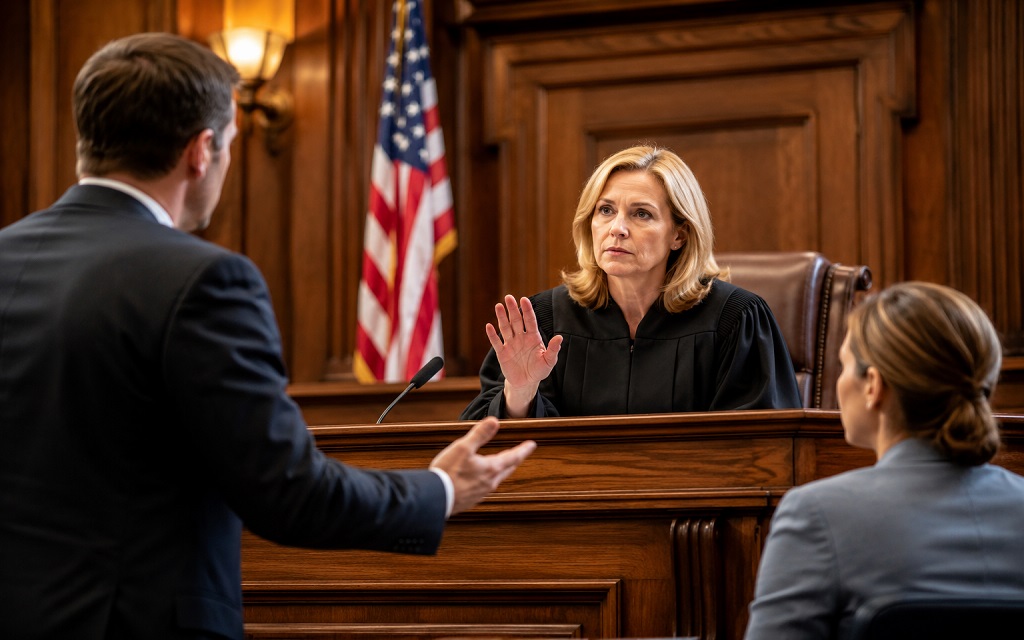
When a judge says “sustained,” it means the judge agrees with an attorney’s objection. The question may be stopped, the witness may not answer, or certain evidence may not be allowed. It does not mean one side won the case. It only means the judge found a problem with that specific question, answer, or piece of evidence.
You may hear the word “sustained” during criminal trials, civil lawsuits, personal injury claims, family law disputes, and many other court proceedings.
Although the term appears frequently in courtrooms and legal news coverage, many people misunderstand what it actually means. Understanding how sustained objections work can help you follow trial testimony, court rulings, and legal proceedings more accurately.
Example:
Attorney: “Didn’t your neighbor tell you the defendant caused the accident?”
Opposing Attorney: “Objection, hearsay.”
Judge: “Sustained.”
The witness cannot answer because the question relies on information from someone who is not testifying in court.
What Does Sustained Mean in Court?
In court, the term “sustained” means the judge agrees with an objection raised by an attorney.
During a trial, lawyers ask questions, present evidence, and examine witnesses. If an attorney believes a question or piece of evidence violates a legal rule, that attorney may object. The judge must then decide whether the objection has merit.
When the judge says “sustained,” the objection is granted. The court has determined that the question, testimony, or evidence should not proceed in its current form.
The exact effect depends on the situation. Sometimes a witness is prevented from answering a question. In other cases, testimony is removed from the record or evidence is excluded from consideration. The attorney may also receive an opportunity to rephrase the question and continue the examination in a legally acceptable manner.
It is important to understand that a sustained objection is a procedural ruling. The judge is not deciding who is telling the truth or who will win the case. The ruling addresses only whether a particular question, answer, or piece of evidence complies with courtroom rules.
What Happens After a Judge Says “Sustained”?
Court proceedings usually continue immediately after a sustained objection.
In many situations, the attorney who asked the question simply tries again using different wording. If the objection involved hearsay, speculation, or another evidentiary issue, the lawyer may need to establish additional facts before proceeding.
Consider a common example. An attorney asks a witness, “Isn’t it true that everyone in the neighborhood said the defendant caused the accident?” The opposing attorney objects on hearsay grounds. If the judge sustains the objection, the witness cannot answer that question because it relies on statements made by other people outside the courtroom.
The attorney may then ask a new question that focuses on the witness’s personal observations rather than information obtained from others.
In some circumstances, the judge may instruct the jury to disregard testimony that was already heard. In other situations, evidence may be excluded entirely. The result depends on the nature of the objection and the stage of the trial.
Why Does a Judge Sustain an Objection?
Judges sustain objections when a question, answer, or piece of evidence violates courtroom rules. The purpose is to keep the trial focused on reliable and legally admissible information.
One common reason is relevance. A judge may sustain an objection if the testimony or evidence does not relate to the issues the court must decide.
Hearsay is another frequent reason. Courts generally do not allow witnesses to repeat statements made by someone outside the courtroom unless a recognized exception applies.
A judge may also sustain an objection to a leading question. This usually happens when an attorney suggests the answer while questioning their own witness during direct examination.
Speculation can also trigger a sustained objection. Witnesses must testify about facts they personally observed rather than assumptions or guesses.
Some objections arise because a question is argumentative. Instead of seeking facts, the attorney may appear to be debating with the witness or attempting to persuade the jury.
A judge may also sustain an objection for lack of foundation. In that situation, the attorney has not established that the witness has the necessary knowledge or background to answer the question accurately.
What Is the Difference Between Sustained and Overruled?
Sustained and overruled are opposite judicial rulings.
When an objection is sustained, the judge agrees with the attorney who objected. When an objection is overruled, the judge disagrees and allows the questioning or evidence to continue.
| Court Ruling | Meaning |
|---|---|
| Sustained | The judge agrees with the objection |
| Overruled | The judge rejects the objection |
| Withdrawn | The attorney removes the objection |
The practical difference can be significant. A sustained objection often prevents a witness from answering a question or limits the use of evidence. An overruled objection allows the attorney to continue and permits the witness to respond.
For example, an attorney may ask a witness where they were standing when they observed a vehicle collision. The opposing attorney objects, arguing that the question is irrelevant. If the judge overrules the objection, the witness may answer because the location could help establish what the witness saw and how reliable the testimony may be.
Understanding the difference between sustained and overruled is essential because both rulings occur frequently throughout civil and criminal trials.
Does Sustained Mean Someone Won the Case?
No. A sustained objection does not determine the outcome of a lawsuit or criminal prosecution.
Many people assume a sustained objection represents a major victory for one side. Television programs often reinforce this misunderstanding by portraying objections as dramatic turning points. Real court proceedings are far more complex.
A sustained objection addresses a specific evidentiary issue at a particular moment during the trial. The ruling does not determine liability, guilt, innocence, damages, negligence, or any other final issue before the court.
Judges sustain objections in cases that plaintiffs win and in cases that plaintiffs lose. The same is true in criminal proceedings. A prosecutor may receive sustained objections during a successful prosecution, while a defense attorney may receive sustained objections during a successful defense.
The outcome usually depends on the totality of admissible evidence, witness testimony, expert opinions, legal arguments, and the applicable law. A single objection rarely determines the result of an entire case.
Why Do Lawyers Object?
Attorneys object because courts operate under rules that govern what evidence jurors and judges may consider.
Without objections, parties could introduce unreliable information, misleading testimony, or evidence that unfairly influences the fact-finding process. Objections help maintain fairness and protect the integrity of judicial proceedings.
The legal system relies heavily on evidence rules. These rules determine what information may be presented to the jury and how that information must be introduced. Attorneys use objections to alert the court when they believe a rule has been violated.
Objections also serve another important purpose. They preserve legal issues for appeal. In many cases, an attorney must object during trial before challenging the issue in a higher court. Failure to object may prevent the issue from being reviewed later by an appellate court.
As a result, objections are not merely courtroom interruptions. They are an essential part of the trial process and help ensure that legal standards are properly applied.
What Are Common Objections in Court?
Several objections appear regularly in courtrooms across the United States.
One of the most common objections involves hearsay. Hearsay generally refers to an out-of-court statement offered to prove the truth of what was said. Courts often exclude hearsay because the original speaker is not present for questioning and cross-examination.
Another frequent objection involves relevance. Evidence must relate to an issue that matters in the case. If information has little or no connection to the dispute before the court, the judge may exclude it as irrelevant.
Leading questions also generate objections. A leading question suggests the desired answer rather than allowing the witness to provide an independent response. Such questions are often restricted during direct examination.
Attorneys may also object when a witness is speculating rather than testifying from personal knowledge. Courts generally require witnesses to describe what they observed, heard, or experienced rather than offering guesses about another person’s intentions or beliefs.
Other common objections include argumentative questioning, lack of foundation, and repetitive questioning that has already been answered by the witness.
These objections arise in both civil litigation and criminal proceedings and play an important role in ensuring that testimony remains reliable and legally admissible.
Can a Sustained Objection Affect the Outcome of a Trial?
A sustained objection can affect a trial, but its impact varies greatly depending on the circumstances.
Some sustained objections involve routine matters that have little effect on the overall case. An attorney may simply rephrase a poorly worded question and continue examination without any meaningful consequence.
Other objections involve critical evidence. A ruling that excludes important documents, expert testimony, admissions, or key witness statements may significantly influence how the facts are presented to the jury.
Even then, a sustained objection does not automatically determine the outcome. Courts evaluate evidence as a whole rather than focusing on a single ruling.
In certain cases, evidentiary decisions become important during the appellate process. An appellate court may review whether the trial judge correctly applied the law. However, appellate courts often distinguish between harmless errors and errors that substantially affected the fairness of the proceeding.
For that reason, the significance of a sustained objection depends on the nature of the evidence involved and the overall strength of the case.
FAQs
What does sustained mean in a criminal case?
In a criminal case, sustained means the judge agrees that a question, answer, or piece of evidence violates a legal rule. The witness may be prevented from answering, or the evidence may be excluded from consideration by the jury.
Can a lawyer continue after an objection is sustained?
Yes. Attorneys often rephrase the question, establish additional foundation, or introduce the evidence through another witness who can provide admissible testimony.
What happens if a witness answers before the judge rules?
The judge may strike the answer from the record and instruct the jury to disregard the testimony.
Can a sustained objection be appealed?
Sometimes. Appellate courts may review evidentiary rulings if the issue was properly preserved and the ruling affected a substantial right of one of the parties.
What does sustained mean during cross-examination?
The meaning is the same. The judge has determined that a question, answer, or piece of evidence violates a courtroom rule and cannot proceed in its current form.
Conclusion
A sustained objection means the judge agrees that a question, answer, or piece of evidence violates a legal rule. The ruling may prevent a witness from answering, require an attorney to rephrase a question, or exclude evidence from consideration. However, a sustained objection does not decide who wins a case, establish liability, or prove guilt.
Judges use sustained and overruled rulings to enforce courtroom procedures and evidence rules. These decisions help ensure that courts rely on relevant, reliable, and admissible evidence when resolving disputes.
Whether a case involves a criminal charge, personal injury claim, contract dispute, or family law matter, understanding what sustained means makes it much easier to follow courtroom proceedings and judicial decisions.

Musarat Bano is a content writer for JudicialOcean.com who covers lawsuits, legal news, and general legal topics. Her work focuses on research-based, informational content developed from publicly available sources and is intended to support public awareness. She does not provide legal advice or professional legal services.