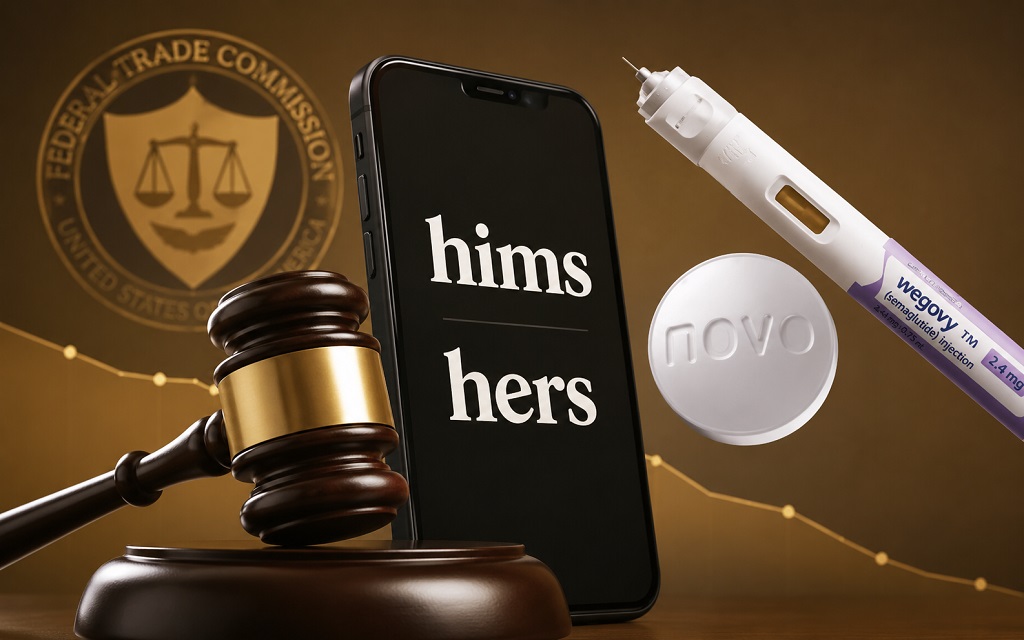
The FTC, Utah, and Los Angeles County sued Hims & Hers in federal court on July 29, 2026. The complaint alleges that Hims & Hers charged customers right after an intake form, hid the cancel button, and sent health data to Meta and Snap. Hims & Hers denies all of it. No court has ruled as of September 2026.
You probably landed here for one of three reasons. You used Hims & Hers and saw a charge you did not expect. Also, you own the stock and watched it drop. Or you run a subscription business and want to know if this could happen to you. This article covers all three. It also covers the part the July news stories missed: the case has grown a lot in five weeks.
The FTC filed suit against Hims & Hers on July 29, 2026
The case is FTC v. Hims & Hers Health, Inc., case number 3:26-cv-07871, in the U.S. District Court for the Northern District of California. Two co-plaintiffs joined the FTC. The Utah Division of Consumer Protection sued under Utah law. Los Angeles County Counsel sued on behalf of the People of California.
The commission voted 2-0 to authorize the complaint. The FTC asks the court for a permanent injunction, money for consumers, and civil penalties. The amount is not specified.
This did not come out of nowhere. The FTC sent Hims & Hers a Civil Investigative Demand in October 2023. That is a formal request for documents. So the agency spent almost three years on this before it sued. You can read the full complaint on the FTC’s case page. It is worth a skim, because the news coverage left out most of the detail.
The complaint makes three core allegations
The FTC’s case rests on three claims. Each one is an allegation, not a proven fact. Keep that in mind as you read.
Claim one: you get charged before you talk to anyone. Hims & Hers ads say you can connect with a medical provider to find the treatment that is right for you. The intake form asks for your card. The complaint says the site promises no charge until a prescription is written. Then, per the FTC, most customers get charged and enrolled in a recurring plan shortly after they hit submit. No consult. No chance to review the treatment. One consumer complaint quoted in the FTC’s release says Hims & Hers “charged me immediately” even though the person expected to speak with a doctor first.
Claim two: the cancel button was hidden. Most customers could only cancel through phone, email, or chat before 2023. Hims & Hers added online cancellation in 2023. The complaint says the button was still buried. You had to click “add/remove items from order” and then move through several more screens before the word “cancel” appeared. The FTC also says the site did not clearly tell you when the next refill would ship, so you could miss the cutoff.
Claim three: your health data went to ad platforms. Hims & Hers promised privacy. The complaint says it shared customer data with Meta, Snap, and others in two ways. First, it uploaded lists of certain customers to those platforms. Second, it ran third-party trackers on its website that sent “Events” to those platforms automatically. An event is an action you take on the site, like a page view or a click.
The legal hooks are Section 5 of the FTC Act, Section 4 of the Restore Online Shoppers’ Confidence Act (ROSCA), Utah’s Consumer Sales Practices Act, and California’s Unfair Competition Law and False Advertising Law.
Hims & Hers denies every claim
Hims & Hers published its response the same day. The company called the claims baseless and said the lawsuit “contorts the law to try to manufacture claims.” It says it gave the FTC substantial evidence over the three-year investigation and that the agency ignored it. It also says the complaint ignores state telehealth laws and industry norms.
There is a timeline detail worth a moment of your attention. The FTC’s demand letter arrived in October 2023. Hims & Hers rolled out online cancellation to most customers in 2023. The company has not said the two are connected. You can decide what to make of it.
One fair point for the company: it has served millions of people since 2017, and none of the allegations have been tested in court. Both sides get to make their case. That process has barely started.
The case has grown since July
This is the part the July 29 news stories cannot tell you. Here is what has happened, in order.
- May 2026: Hims & Hers disclosed a $15 million probable-loss accrual for the FTC matter and said it had made a settlement offer without an admission of fault.
- July 29, 2026: The FTC filed. HIMS stock fell $4.32, or 14.7%, to close at $25.00. That wiped out roughly $970 million of market value in one session.
- July 30, 2026: The law firm Lowey Dannenberg filed the first consumer class action, one day after the FTC.
- Q2 10-Q (as of June 30, 2026): Hims & Hers raised its legal accrual for the FTC matter to about $60 million, per its 10-Q. That is four times the May figure.
- Consumer privacy class action: Doe v. Hims & Hers Health, Inc. is now on file in the same court. It brings claims under the Electronic Communications Privacy Act, the California Invasion of Privacy Act, and California’s Confidentiality of Medical Information Act. It seeks statutory, compensatory, and punitive damages plus an injunction.
- Early September 2026: Investors filed a securities class action. It names CEO Andrew Dudum and CFO Oluyemi Okupe as defendants. The class period runs from August 4, 2025 to July 29, 2026. The lead plaintiff deadline is November 2, 2026.
Hims & Hers says it will fight all of the follow-on suits, which it calls reliant on the same flawed allegations.
The $60 million number matters more than the headlines. Companies set these accruals based on what they think they will probably pay. Hims & Hers moved that number up sharply between May and August. That tells you how the company’s own lawyers read the risk, even as its public statements stay defiant.
Hims customers have no refunds yet, but three steps matter now
No refund program exists as of September 2026. The FTC asked for money for consumers, but a judge has to grant it, or the parties have to settle. Either path takes months at minimum.
Still, you can do three useful things right now.
Step 1: File a report at ReportFraud.ftc.gov. This takes about five minutes. The FTC uses these reports to build cases and, later, to run refund programs. The agency will need to know who was affected if a refund program comes out of this case. Your report puts you on the record. Include the date you submitted the intake form and the date of the first charge.
Step 2: Save your evidence. Screenshot your order history, your emails from Hims & Hers, and your card statement. Note the date you first tried to cancel and what happened. Screenshot the click path if you had to go through “add/remove items from order” to find cancel.
Step 3: Understand the class action. The consumer class action covers a nationwide class and a California subclass. You do not need to sign up to be a class member. Class members get notice if the case settles or wins. Your job now is to keep your records so you can prove you belong.
Here is a real scenario to make this concrete. Say you filled out the hair-loss intake on a Tuesday. The site asked for your card and said you would not be charged until a provider prescribed a treatment. Your card showed a charge on Wednesday. You never saw a provider’s name. That sequence is exactly what the complaint describes. Document it now.
Want to cancel today? Go to your account, open your subscription, and record every screen you pass through. Then email support to confirm the cancellation in writing. The email is your proof.
The tracker is the part most people misunderstand
Most readers hear “shared data with Meta” and picture an employee who emails a spreadsheet. The reality is more mundane and more invasive.
A Meta Pixel is a small piece of code on a website. The pixel sends an event to Meta each time you load a page or click a button. The event can include the page URL, the button label, form field values, and a hashed version of your email or phone number. Meta matches the hash to your account. Snap’s tracker works the same way.
Now think about what a URL reveals on a telehealth site. A page path like /erectile-dysfunction/checkout tells the ad platform what you shopped for. No spreadsheet needed. The complaint says these events ran on the Hims & Hers site at the same time the privacy policy promised to keep your health information private.
The second mechanism is a custom audience upload. The company sends a list of customer emails or phone numbers to the ad platform. The platform uses the list to show those people ads, or to find similar users. The complaint says Hims & Hers uploaded lists of certain customers.
There is precedent for this exact fact pattern. The FTC settled with GoodRx and with BetterHelp in 2023 over pixel-based data flows to ad platforms. GoodRx paid $1.5 million. BetterHelp paid $7.8 million. Both agreed to stop the practice. Those numbers are small next to a $60 million accrual, which suggests the FTC sees this case as bigger, or Hims & Hers does. Neither settlement predicts this case’s outcome.
Startups and freelancers should read this as a compliance checklist
You do not need to sell prescriptions to be exposed here. The FTC’s theory reaches any business that sells a subscription online.
The core legal move, per an analysis by Alston & Bird, is that the complaint treats the date of the first charge as a “material term” under ROSCA. ROSCA already requires you to disclose material terms before you take payment. Every checkout flow that collects a card before it states the charge date has a problem if the court agrees that “when you get billed” counts.
Run three checks on your own product.
- Charge date before card field. State the exact day the customer will be billed, above the payment form, in plain text. Not in a tooltip. Not in the terms link.
- Cancel in the same number of clicks as signup. Count the clicks to subscribe. Count the clicks to cancel. Fix it if the second number is higher. A court struck down the FTC’s click-to-cancel rule in 2025, but ROSCA still requires a simple cancellation method, and this complaint shows how the agency reads that.
- Audit every pixel on sensitive pages. Any page whose URL or content reveals a health condition, a financial situation, or a legal problem should not fire a third-party ad tracker. You send that inference to Meta whether you meant to or not.
The context makes this urgent. FTC Chairman Andrew Ferguson launched a Healthcare Task Force in March 2026, as McDermott notes. The Hims & Hers complaint is one of its first major actions. Health-adjacent startups, from sleep apps to supplement subscriptions, are a stated priority.
Small law firm owners should watch the follow-on suits. One enforcement action has already spawned a consumer class action and a securities class action. That is the pattern: the government does the investigation, and private plaintiffs build on the complaint. The lead plaintiff deadline in the securities case is November 2, 2026. Firms with securities or privacy practices have a window.
FAQs
Is the FTC Hims and Hers lawsuit settled?
No. The case is open in the Northern District of California as of September 2026. Hims & Hers has said it will defend itself.
Did Hims & Hers share data with Meta and Snap?
The complaint alleges it did, through customer list uploads and website trackers. Hims & Hers denies the claims. No court has ruled.
Can Hims customers get a refund?
Not yet. No refund program exists. You can file a report at ReportFraud.ftc.gov so you are on record if one is created.
How much has Hims & Hers set aside for the case?
About $60 million as of June 30, 2026, per its Q2 10-Q. The figure was $15 million in May.
Is there a class action against Hims & Hers?
Yes, at least two. A consumer privacy class action (Doe v. Hims & Hers Health, Inc.) and a securities class action that names the CEO and CFO.
What law did Hims & Hers allegedly break?
Section 5 of the FTC Act, Section 4 of ROSCA, Utah’s Consumer Sales Practices Act, and California’s Unfair Competition and False Advertising Laws. These are allegations. The court decides.
Disclaimer: This article is for information only. It is not legal advice.

Musarat Bano is a content writer for JudicialOcean.com who covers lawsuits, legal news, and general legal topics. Her work focuses on research-based, informational content developed from publicly available sources and is intended to support public awareness. She does not provide legal advice or professional legal services.